

5 Tools to Generate Multiple-Choice Questions from a PDF with AI
Written by

Published on
Assessments and tests are important for checking the knowledge and understanding of students as well as their retention in education. Tests and Quizzes are common tools that have been used for centuries to measure how effectively students grasp and remember key concepts. Multiple-choice questions in particular are a popular test form because they’re efficient and fair. However, creating them can be time-consuming. Who really likes spending hours creating Multiple Choice Questions and coming up with answers? Most of the time you already have content ready in the form of PDFs or Word documents. Luckily Artificial Intelligence (AI) is here to simplify the process. In this article, we’ll explore five tools to generate multiple-choice questions from PDFs with the aid of AI tools: SlideSpeak, ChatGPT, Quizgecko, Wayground, and QuizWhiz.
We will also briefly touch on how you can import Multiple Choice Questions into LMS (Learning Management System) like Moodle or Canvas.
By the way: if you just want the result without the tutorial, try our free tool to create a quiz from a PDF. Upload your PDF and it generates the quiz for you.
Looking to create a quiz from a Word document instead? Check out our guide on 6 ways to generate quizzes with AI from Word.
Method 1: Generate multiple-choice questions from a PDF with SlideSpeak
SlideSpeak now comes with a built-in Quiz Generator. Upload your PDF, and SlideSpeak turns it into a presentation plus a ready-to-use multiple-choice quiz that you can edit and download as a PDF, including a separate answer sheet for grading. Whether you’re a teacher looking to enhance your lesson plans or a publisher streamlining content creation, SlideSpeak can save time and boost the learning experience.
SlideSpeak Specs
- Price: Free plan with 100 credits at sign-up, paid plans start at $29 per month
- Content Download Method: Download the quiz as a PDF, with an optional answer sheet for grading
- Customization Options: Choose multiple choice, true/false or both, set 1 to 25 questions, and edit every question manually or with AI
Let’s now explore the steps to generate multiple-choice questions from a PDF with SlideSpeak.
Step-by-step guide to create Multiple Choice Questions with SlideSpeak
Step 1: Upload Your PDF File
Go to app.slidespeak.co and click “Create Presentation”. Upload the PDF document containing the content from which you wish to generate multiple-choice questions, review the generated outline, and pick a template. SlideSpeak will create a presentation based on your PDF, which becomes the basis for the quiz.
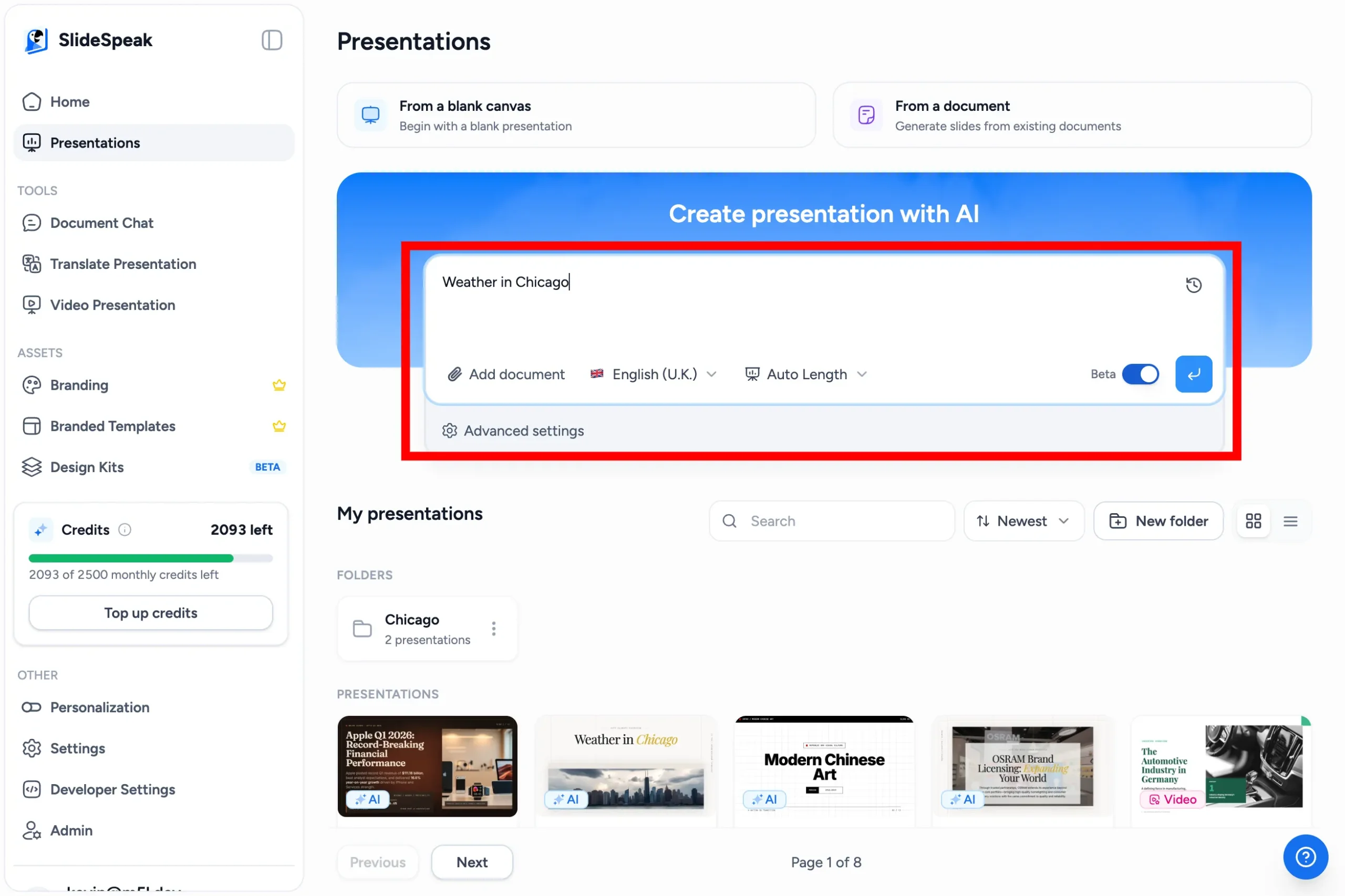
Step 2: Open the Quiz Generator
With your presentation open in the SlideSpeak editor, click “Tools” in the right-hand side panel and select “Generate Quiz”.
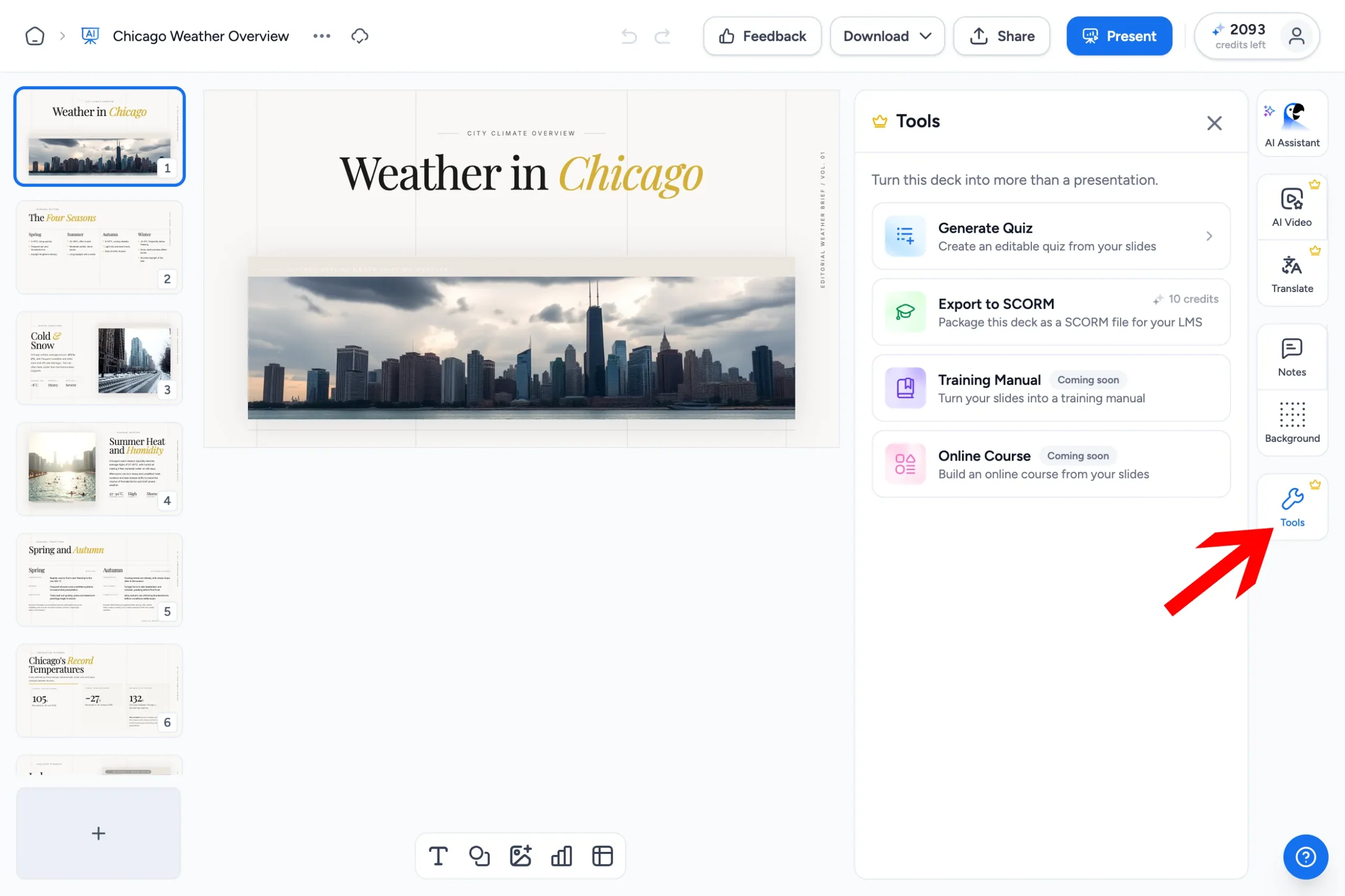
Step 3: Choose Your Quiz Settings
Pick “Multiple choice” as the question type (you can also mix in true/false questions) and use the slider to choose anywhere from 1 to 25 questions. Then click “Generate quiz” and SlideSpeak’s AI will analyze your content and create relevant multiple-choice questions.
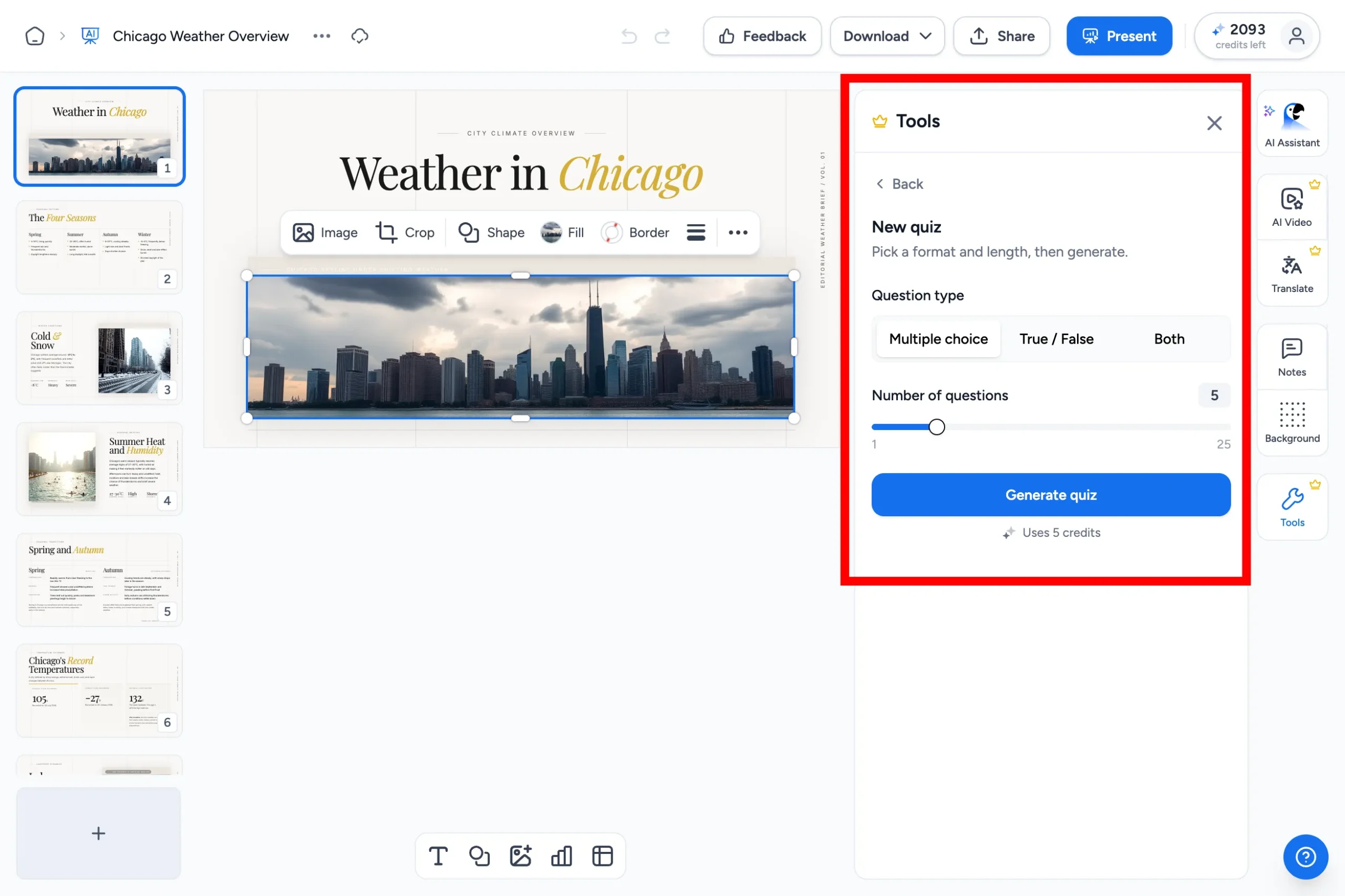
Step 4: Review and Download
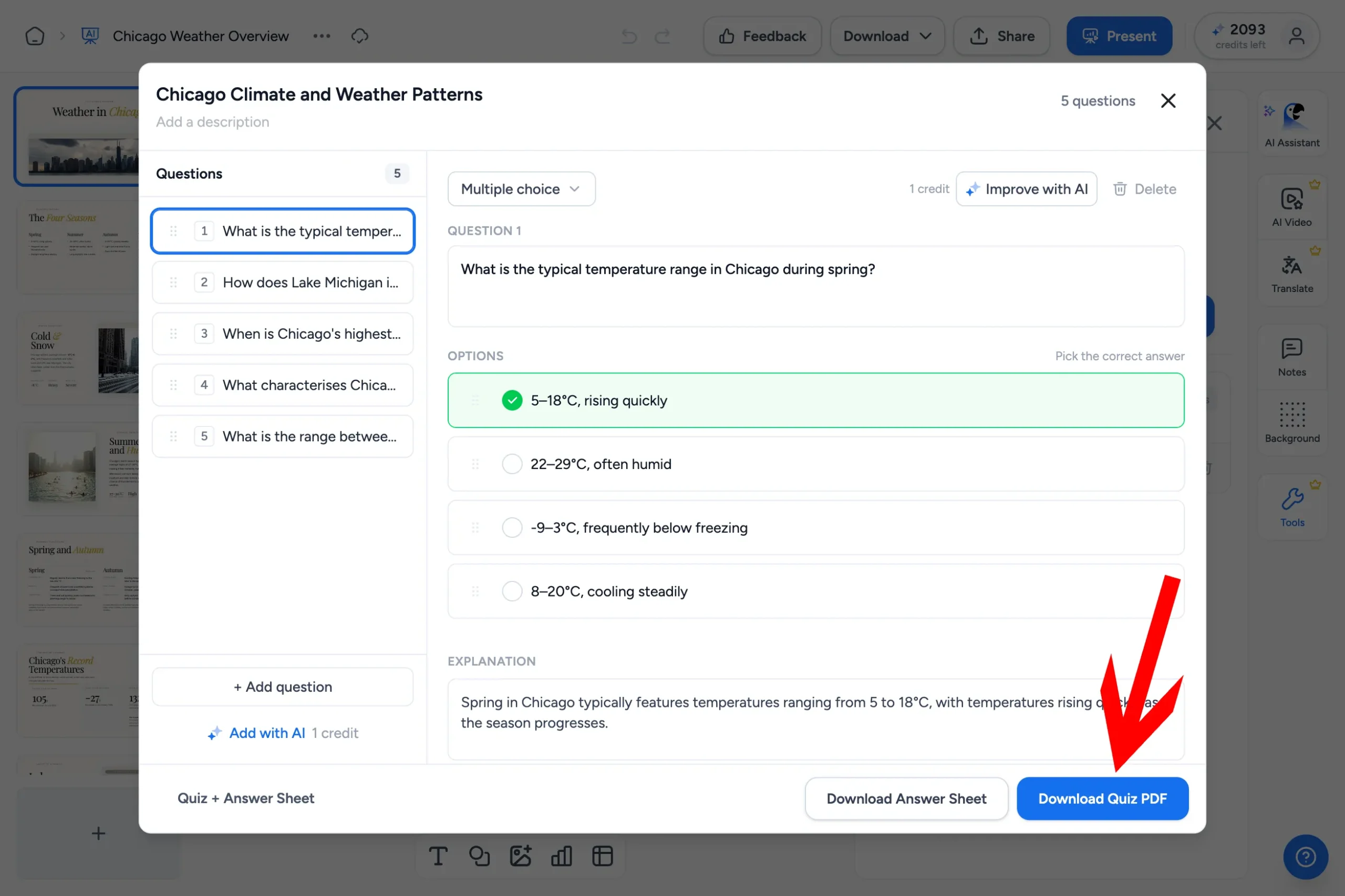
Your quiz opens right inside the SlideSpeak editor. Review the generated multiple-choice questions to ensure accuracy and relevance: change the question text, edit answer options, pick the correct answer, or rewrite a question with AI. You can also add new questions manually or with AI.
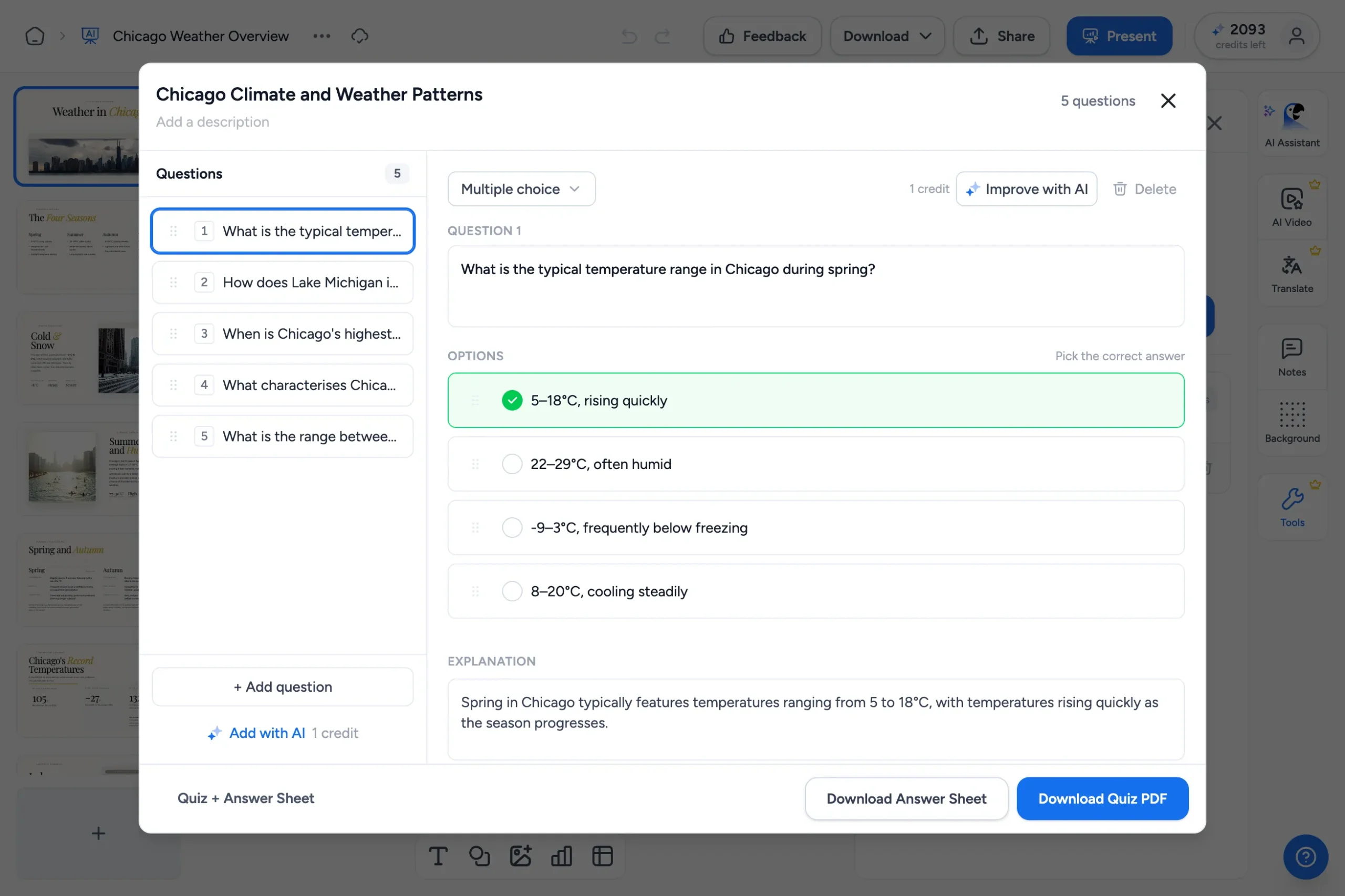
When you’re happy with the quiz, download it as a PDF: the quiz questions, a separate answer sheet for grading, or both together in one file. For a full walkthrough, check out our help article on creating a quiz from a presentation.
Important notes when using SlideSpeak
- Ensure your PDF document is properly formatted and organized to optimize the AI’s extraction process.
- Review the generated multiple-choice questions for clarity, correctness, and appropriateness to the intended learning objectives.
- Use the built-in quiz editor to align questions with specific teaching styles or assessment preferences before downloading.
- Generating a quiz uses 5 credits, so the free plan is enough to try it out on your own material.
Method 2: Generate multiple-choice questions with ChatGPT from a PDF
With ChatGPT, you can integrate AI technology into your workflow to easily extract essential information from PDF documents and craft dynamic multiple-choice questions. The tool is easy to use and accessible to everyone with an internet connection.
ChatGPT Specs
- Price: Free, including file uploads (currently limited to 3 per day), paid plans start at $20 per month
- Content Download Method: Copy and paste
- Customization Options: Tailors multiple-choice questions based on clear instructions and feedback
Let’s now explore the steps to generate multiple-choice questions from a PDF with ChatGPT.
Step-by-step on creating Multiple Choice Questions with ChatGPT
Step 1: Access ChatGPT’s Interface
Navigate to ChatGPT’s platform and either sign in or create an account to begin your multiple-choice question generation journey.
Step 2: Upload Your PDF
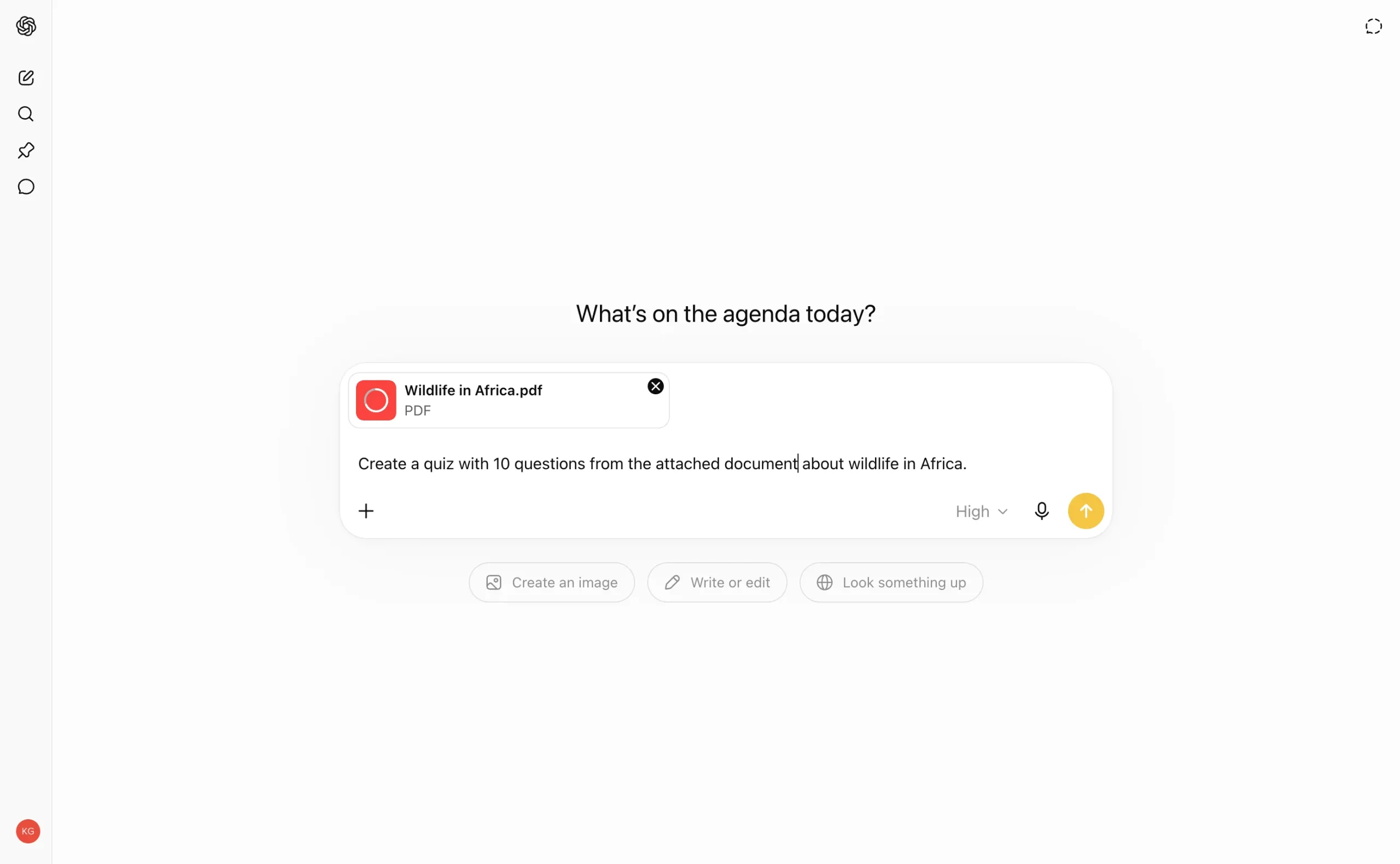
Use the “+” button within the chat interface to attach your PDF document. File uploads are also available on the free plan (with a daily limit), so you do not have to pay to upload PDFs.
Step 3: Engage with ChatGPT
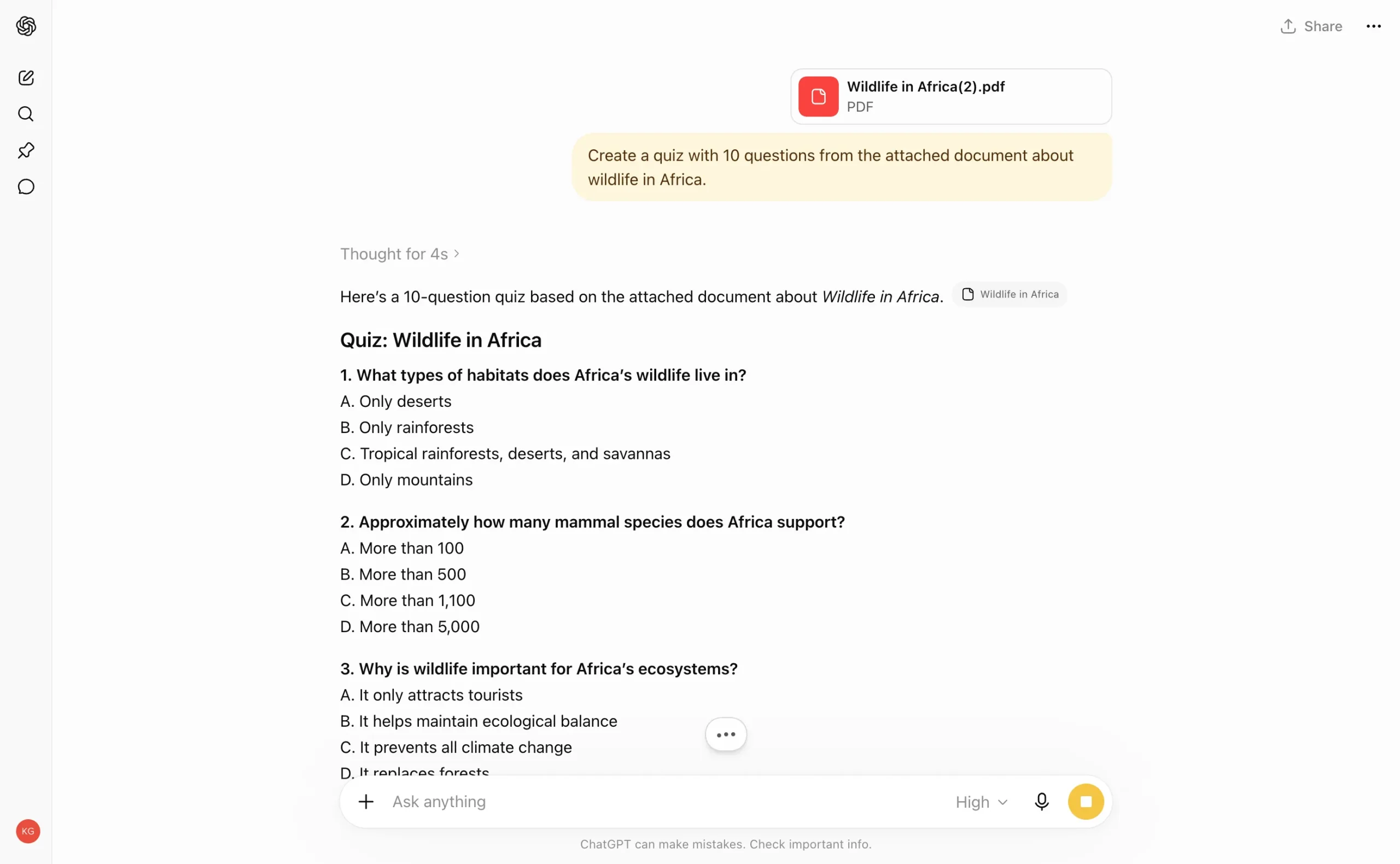
Provide clear instructions and context to ChatGPT regarding the specific content from which you desire multiple-choice questions. ChatGPT will utilize its advanced language capabilities to generate tailored multiple-choice questions based on your prompts.
Example: “Generate me a quiz with 20 multiple choice questions for the PDF attached” or “Create me 20 Multiple Choice Questions about the Wildlife in Africa covering the topics in the PDF attached”.
Step 4: Refine, Copy, and Implement
Review the multiple-choice questions generated by ChatGPT, refining them as needed to align with your educational objectives. Once polished, you can copy the content and incorporate the multiple-choice questions into your teaching materials.
Important notes when using ChatGPT
- Clearly outline the scope and context of the content to ChatGPT for more accurate multiple-choice question generation.
- Provide feedback to ChatGPT during the multiple-choice question generation process to improve the quality of the questions.
- Images embedded in your PDF may be ignored, ChatGPT focuses on the text of the document.
- Experiment with different prompts and variations to explore the full potential of ChatGPT in crafting diverse multiple-choice questions.
Method 3: Create multiple-choice questions from a PDF with Quizgecko
Quizgecko is an AI study platform that turns your PDFs into practice questions, flashcards, study notes and even podcasts. For educators it has a standout feature: the generated questions can be exported directly in LMS-compatible formats like Moodle (Aiken), Canvas, Blackboard and QTI.
Quizgecko Specs
- Price: Limited free plan, paid plans start at $16 per month (cheaper on yearly billing)
- Content Download Method: Export to Moodle (Aiken), Canvas, Blackboard, QTI, CSV, Excel, PDF and printable worksheets
- Customization Options: Pick question types and difficulty, edit questions after generation
Step-by-step guide for Quizgecko Multiple Choice Questions
Step 1: Upload Your PDF to Quizgecko
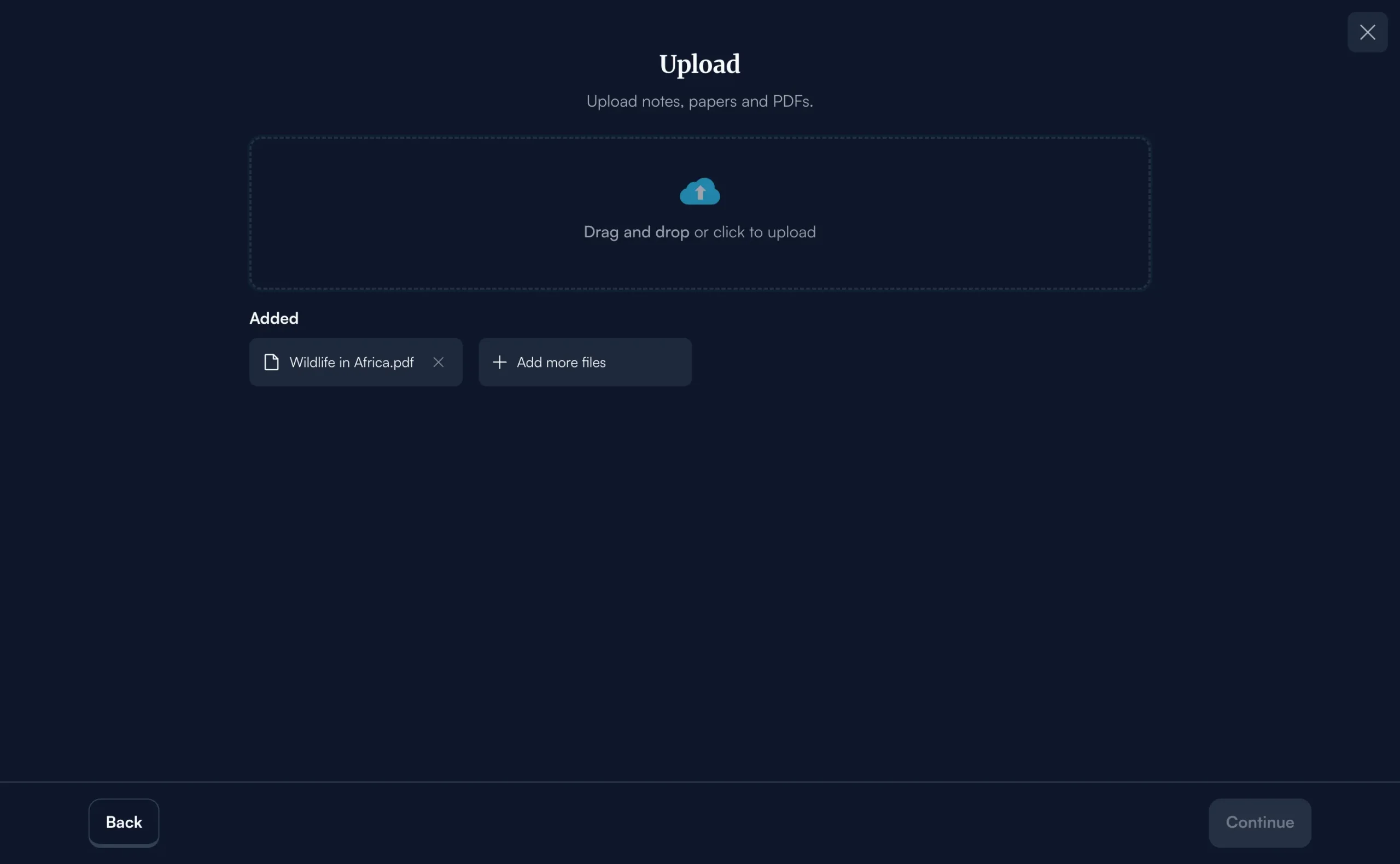
Sign up at Quizgecko, click “Generate” and choose “Upload” to add your PDF document. You can also generate from Google Drive files, links, YouTube videos, recorded audio or plain text.
Step 2: Configure the Questions
Select “Questions” as the output and pick the question types and how hard they should be. You can also add flashcards, study notes or a podcast in the same run. Then hit “Generate”.
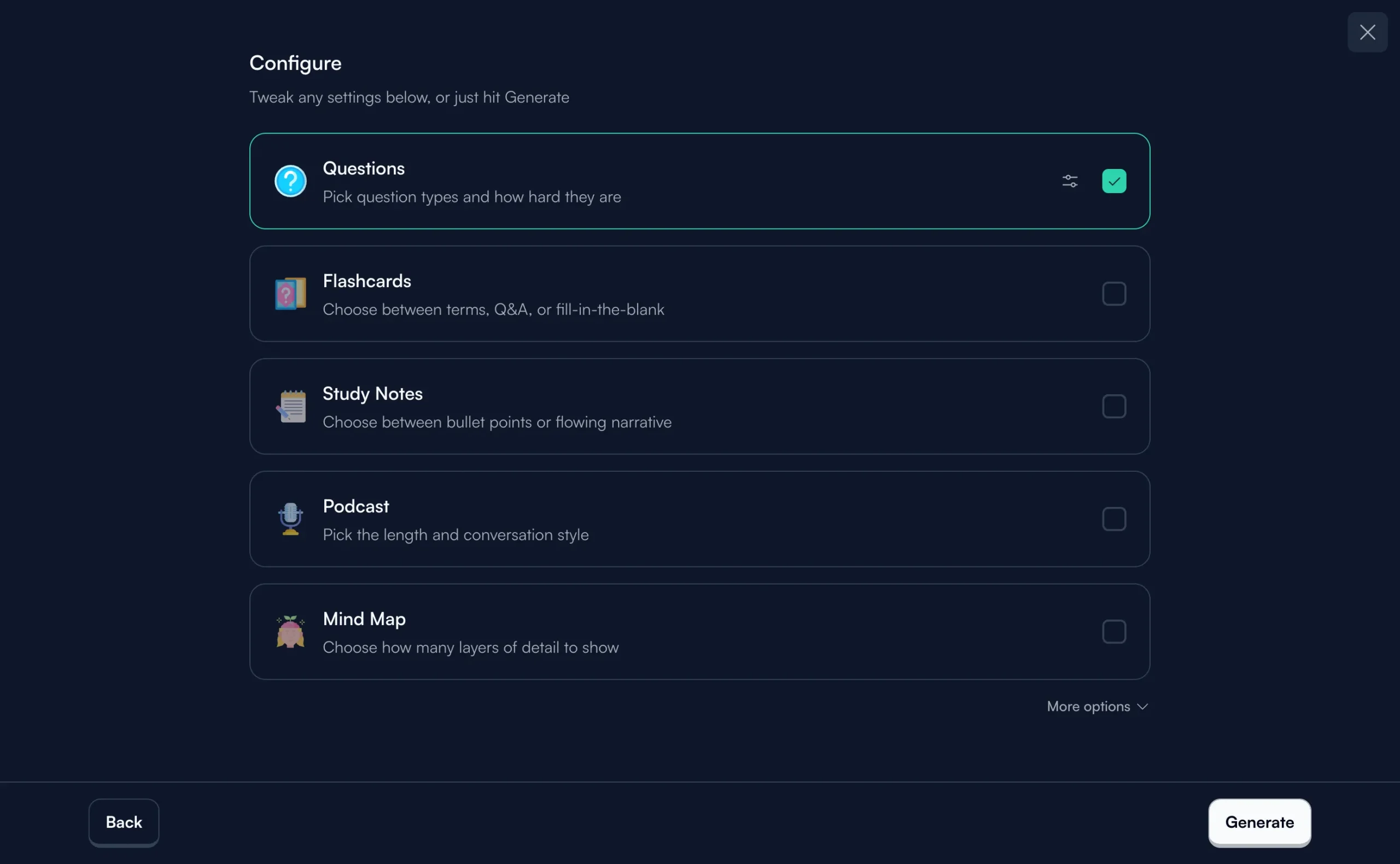
Step 3: Take, Review or Export
After the questions are generated, you can start the quiz right away, review and edit the questions, or export them. The export options are excellent for educators: Moodle (Aiken format), Canvas, Blackboard, Brightspace, Schoology, Sakai, QTI, CSV, Excel, PDF and printable worksheets.
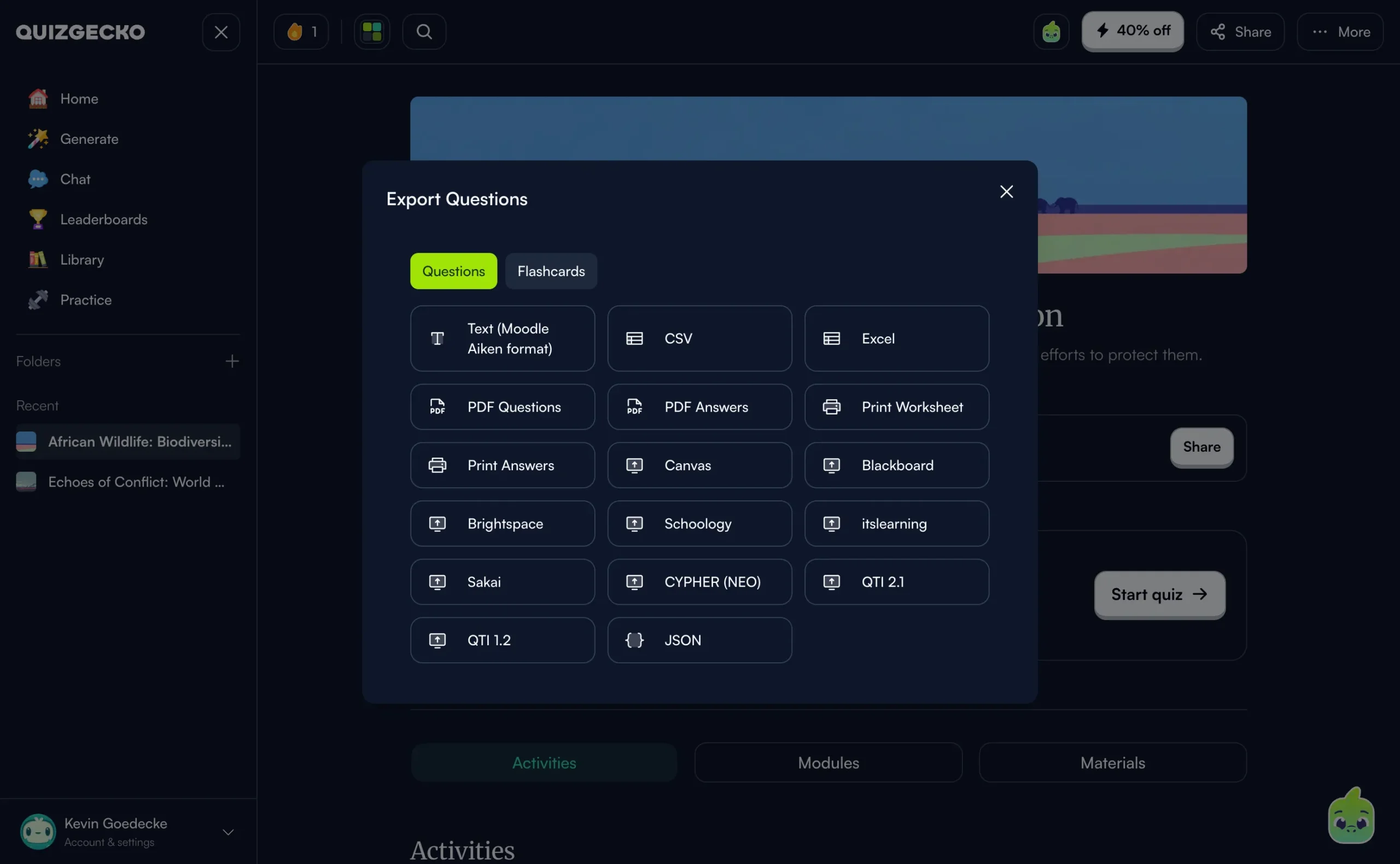
Important notes when using Quizgecko
- The free plan is limited to a few quizzes per month, so test it with your most important material first.
- Pick the export format that matches your LMS before downloading to avoid manual conversion.
- Review the generated questions for accuracy and coverage of key concepts before sharing them with students.
Method 4: Generate multiple-choice questions from a PDF with Wayground (formerly Quizizz)
Wayground (known as Quizizz until its 2025 rebrand) is built for classrooms: it turns your PDF into an online assessment that you can assign as a live game or homework, with auto-grading and instant feedback. If you want students to take the quiz online rather than on paper, this is the strongest option.
Wayground Specs
- Price: Generous free plan for individual teachers, paid plans start at around $5 per month, school plans are custom
- Content Download Method: Assign online as a live game or homework with auto-grading
- Customization Options: Grade level, depth of knowledge, question types, number of questions and output language
Step-by-step guide for Wayground Multiple Choice Questions
Step 1: Upload Your PDF to Wayground
Sign up at Wayground, create a new assessment and upload your PDF (up to 50 MB and less than 100 pages) from your device or Google Drive. You can also paste a link or start from a prompt.
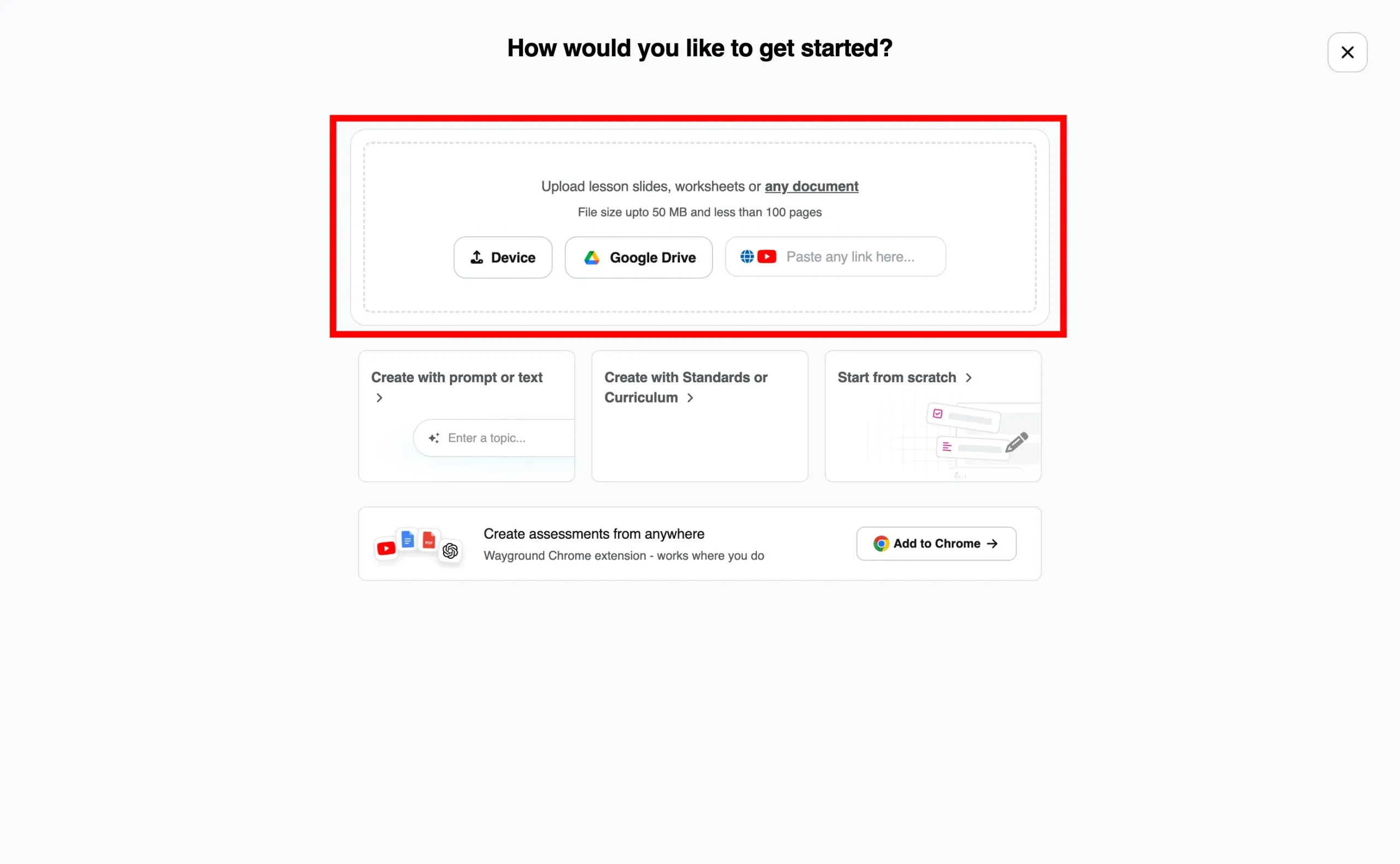
Step 2: Customize Your Assessment
Choose “MCQ” as the question type, then set the grade level, depth of knowledge, number of questions and output language before generating.
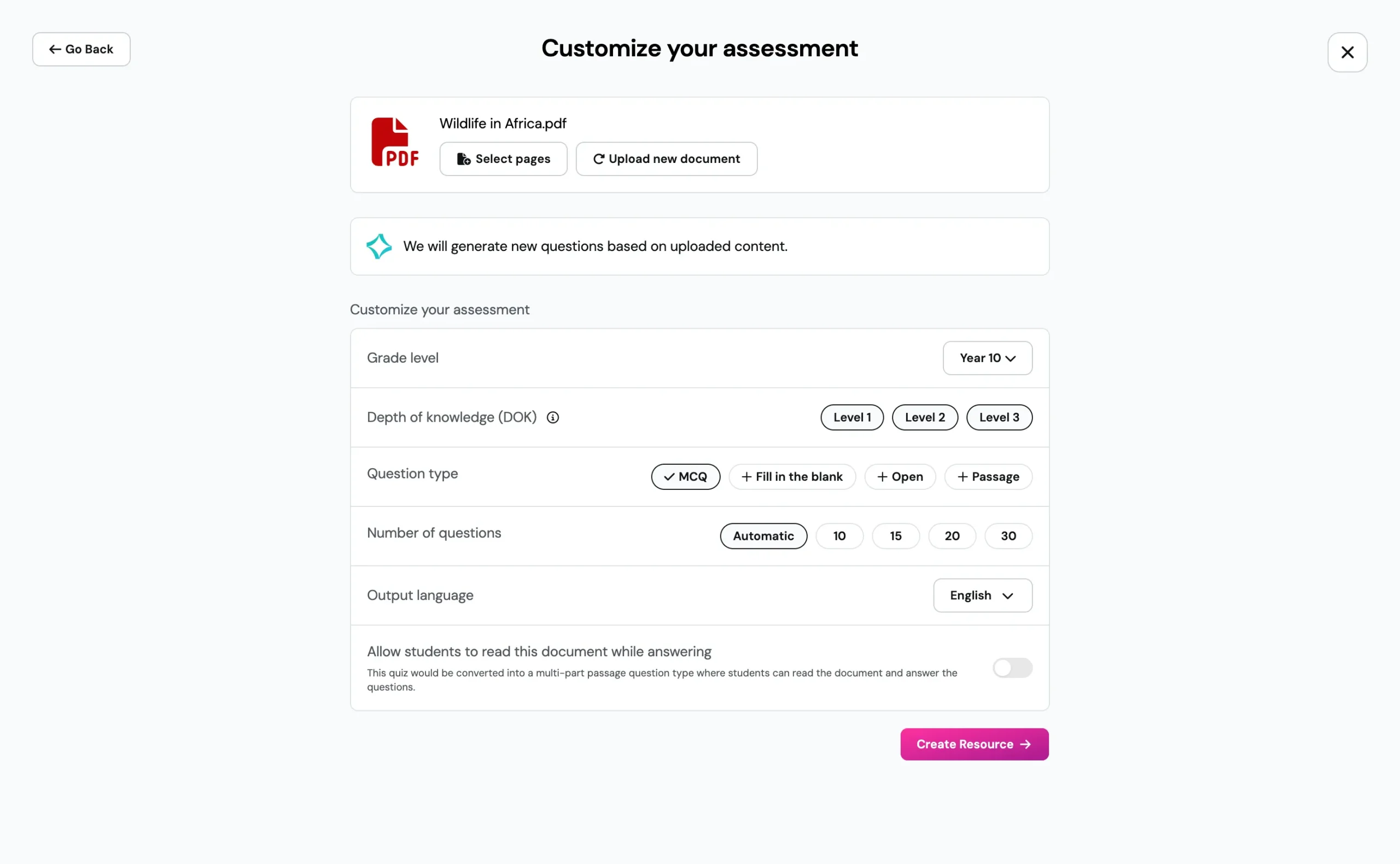
Step 3: Review and Assign
Review the generated questions in the editor. You can edit question text and answer options, and use AI actions like “Add similar questions”, “Add answer explanations” or “Translate quiz”. Once you are satisfied, publish the quiz and assign it as a live game or homework.
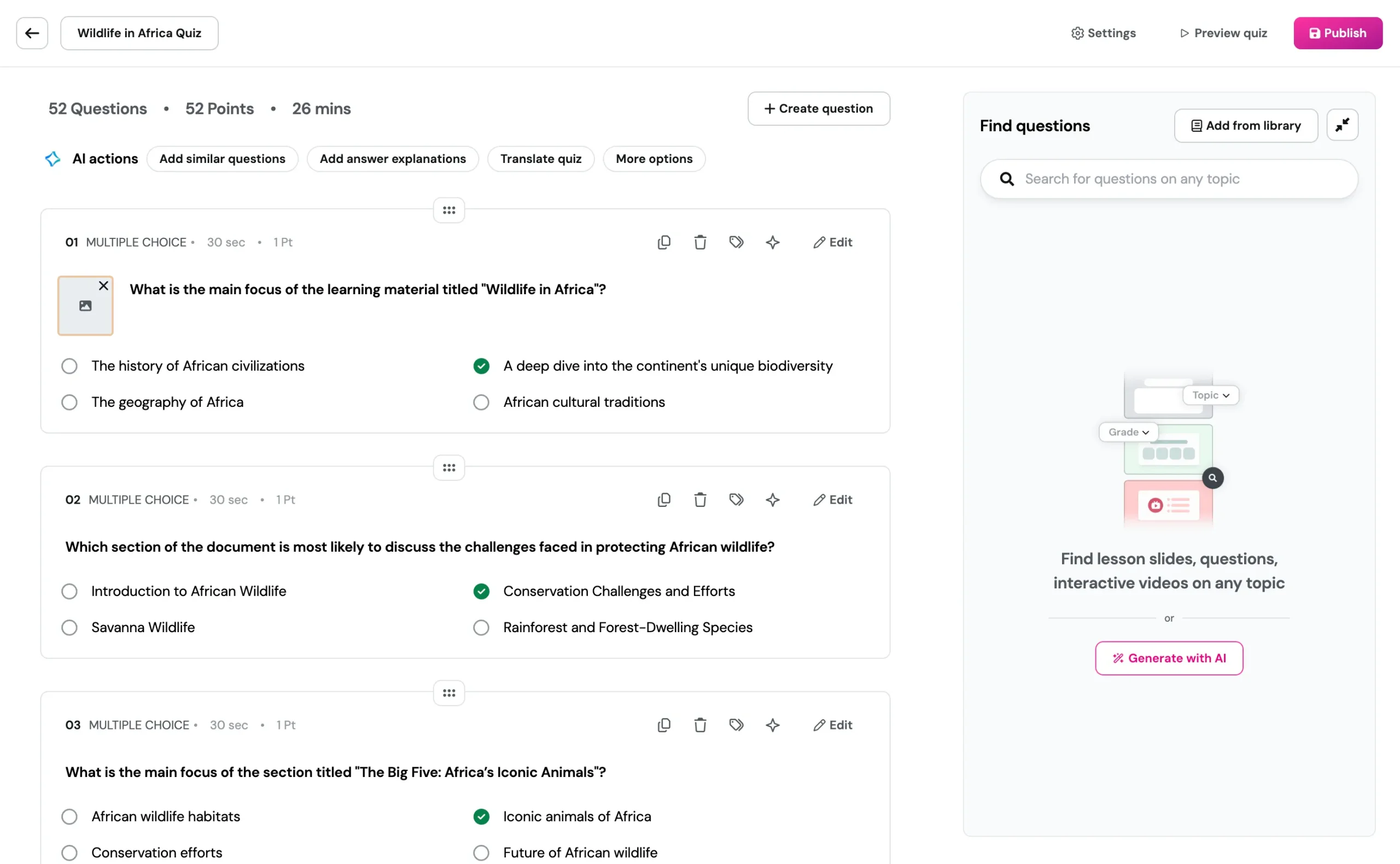
Important notes when using Wayground
- Wayground is online-first: students take the quiz in the browser or app, so it is less suited for printed handouts.
- Keep your PDF under 50 MB and 100 pages, split larger textbooks into chapters first.
- Review the generated questions for accuracy and adjust the grade level setting if the questions feel too easy or too hard.
Method 5: Create multiple-choice questions from a PDF with QuizWhiz
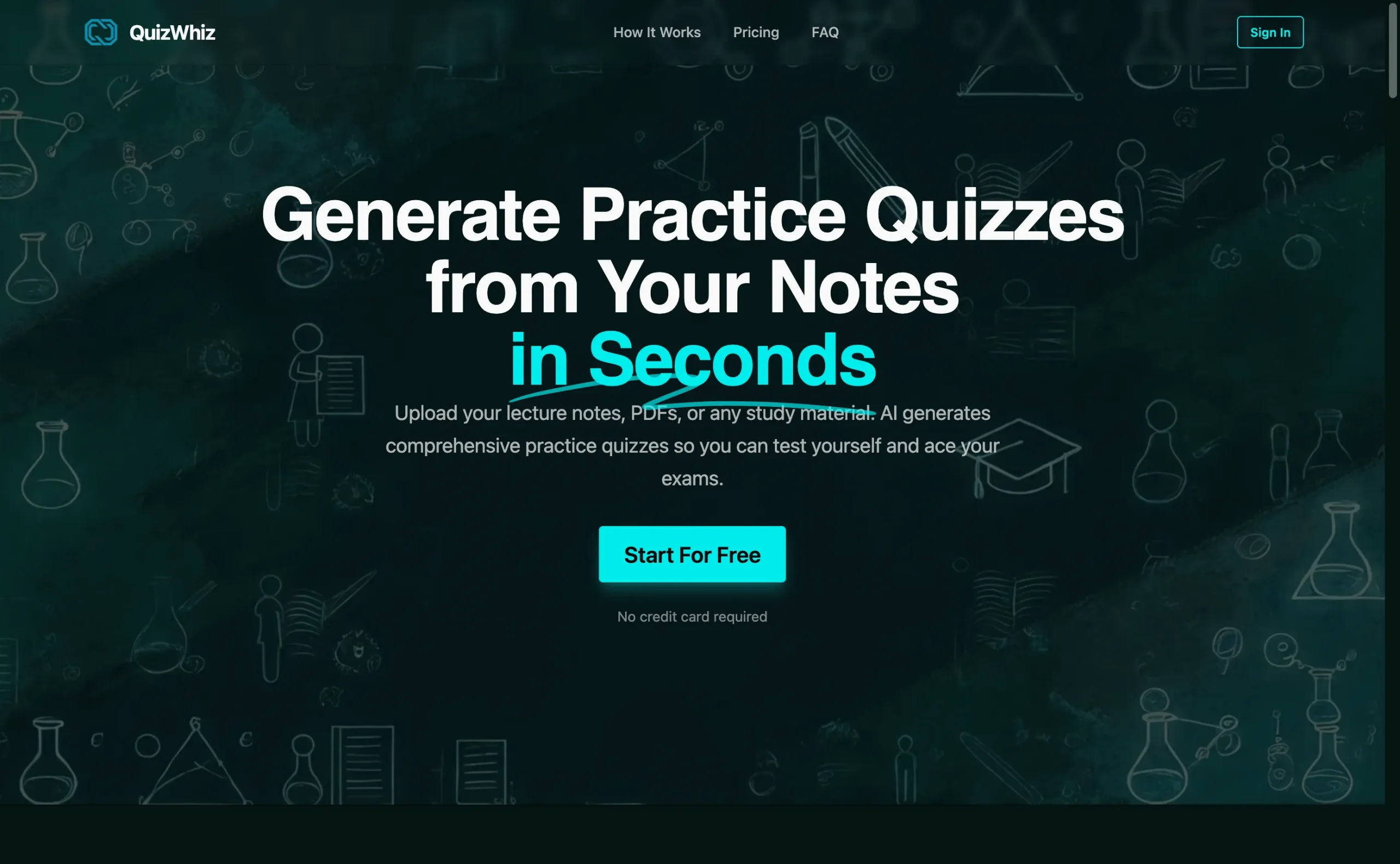
If you’re looking for more AI tools like ChatGPT, QuizWhiz is an easy-to-use AI study platform aimed at students. It generates practice quizzes from PDFs, text, URLs or plain topics, supports five question types (multiple choice, true/false, short answer, fill-in-the-blank and scenario-based), and tracks which skills you have mastered over time.
QuizWhiz Specs
- Price: Free plan with 10 credits, paid plans start at $14 per month
- Content Download Method: PDF, Word, Markdown, plain text, JSON, QTI (Canvas, Moodle, Blackboard), Anki and Quizlet exports, with an optional answer key
- Customization Options: Five question types, question quantity, and a “Higher Order” mode for questions that test understanding rather than recall
Let’s now explore the steps to generate multiple-choice questions from a PDF with QuizWhiz:
Step-by-step guide for QuizWhiz Multiple Choice Questions
Step 1: Create a New Quiz
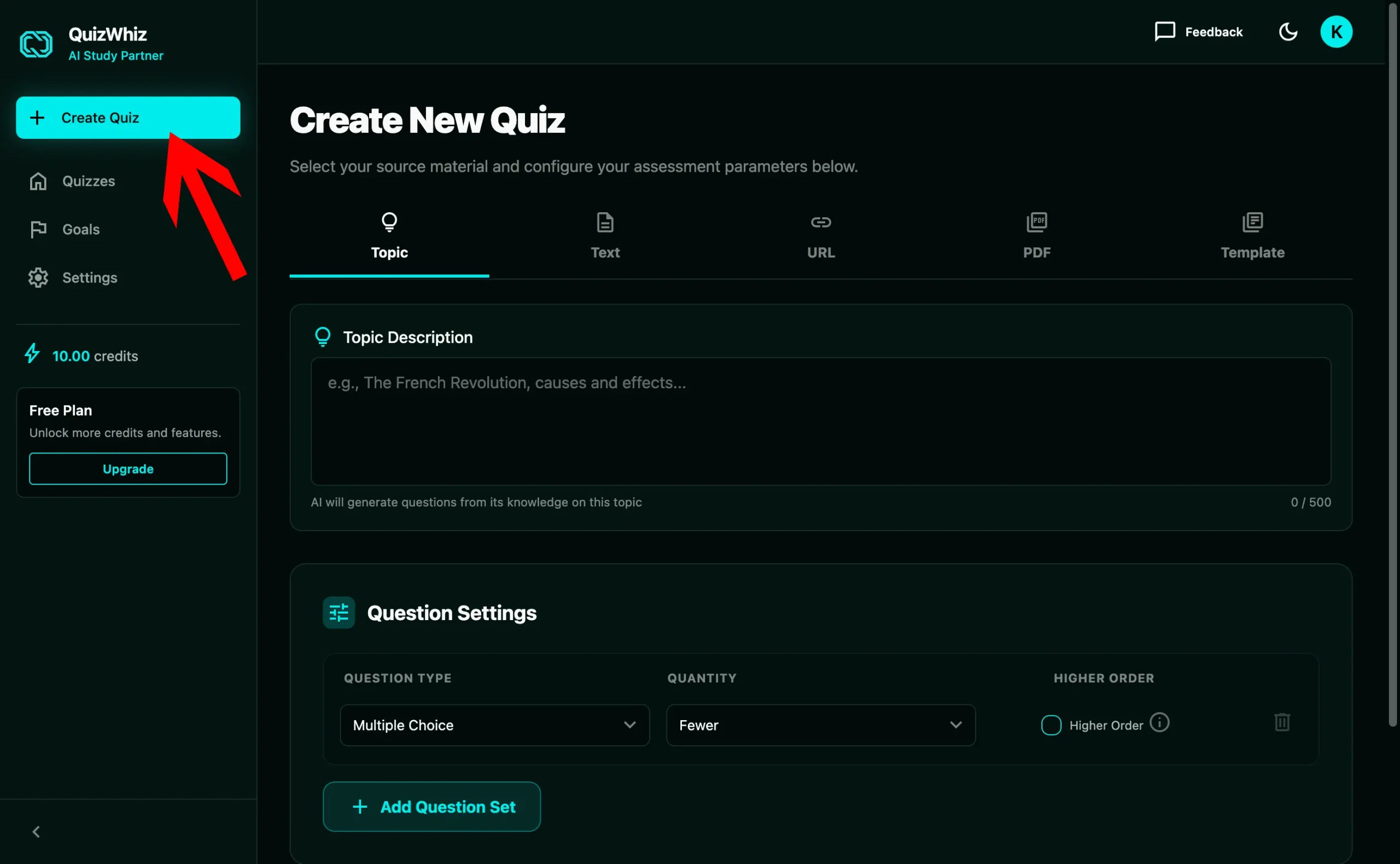
Sign up at QuizWhiz (the free plan starts you off with 10 credits) and click the “+ Create Quiz” button in the sidebar to open the “Create New Quiz” screen.
Step 2: Upload Your PDF
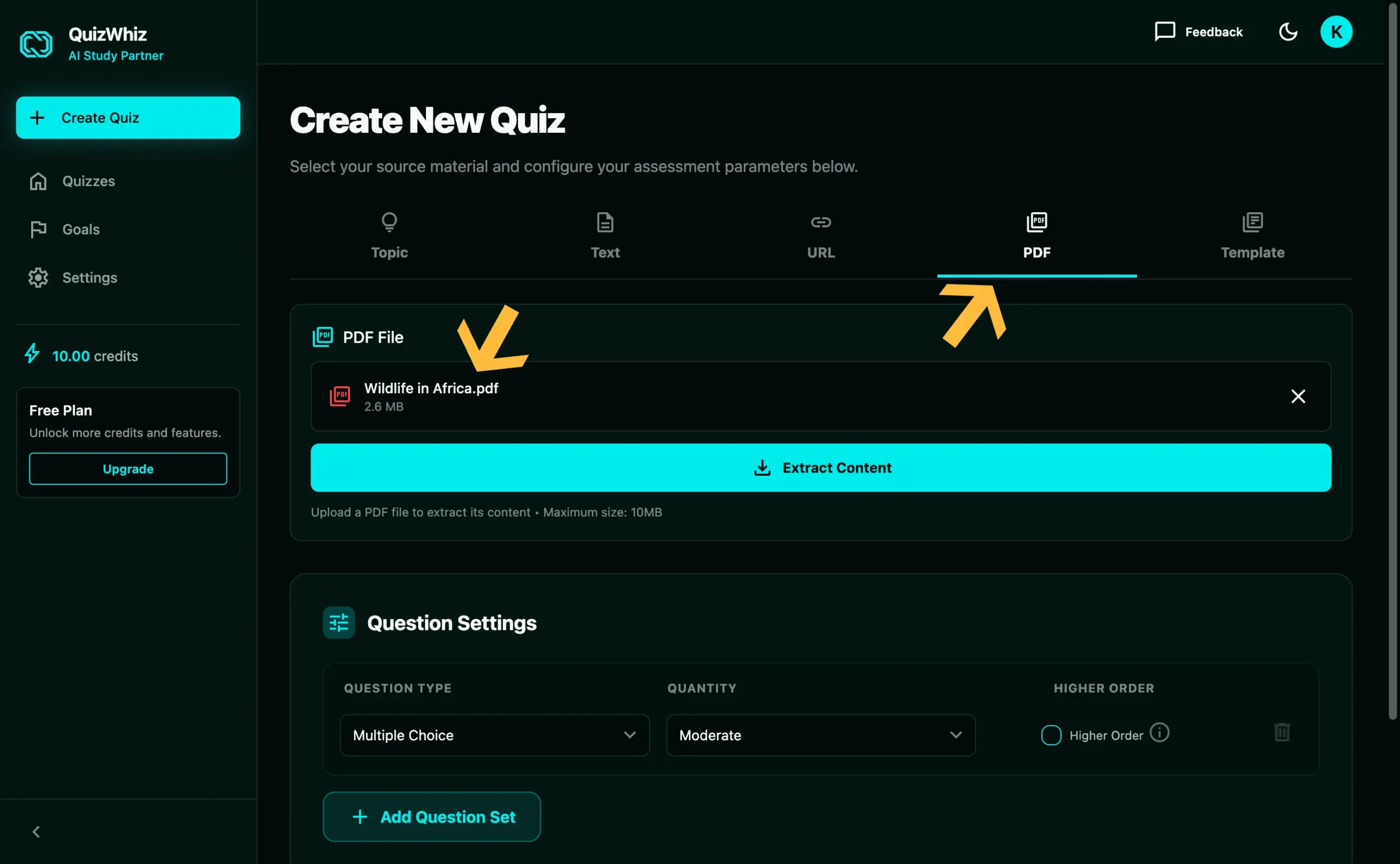
Switch to the “PDF” tab, upload your PDF (up to 10 MB) and click “Extract Content”. You can also generate quizzes from pasted text, a URL or just a topic.
Step 3: Review the Content and Question Settings
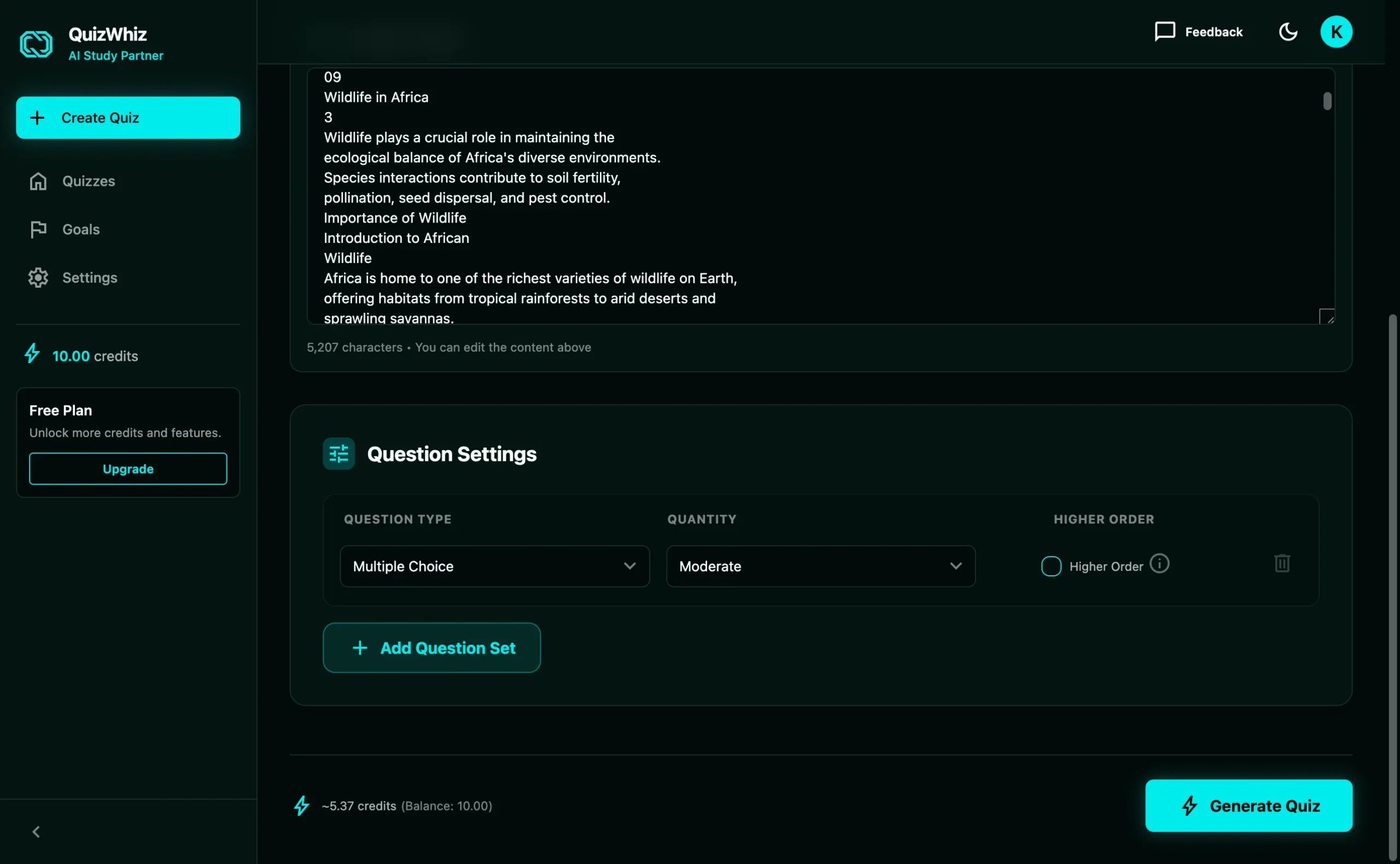
QuizWhiz extracts the text from your PDF and lets you edit it before generating, handy for trimming intros or references. Under “Question Settings”, pick “Multiple Choice” as the question type, choose the quantity, and optionally enable “Higher Order” for more demanding questions. Then click “Generate Quiz” (a typical quiz costs around 5 credits).
Step 4: Review and Practice
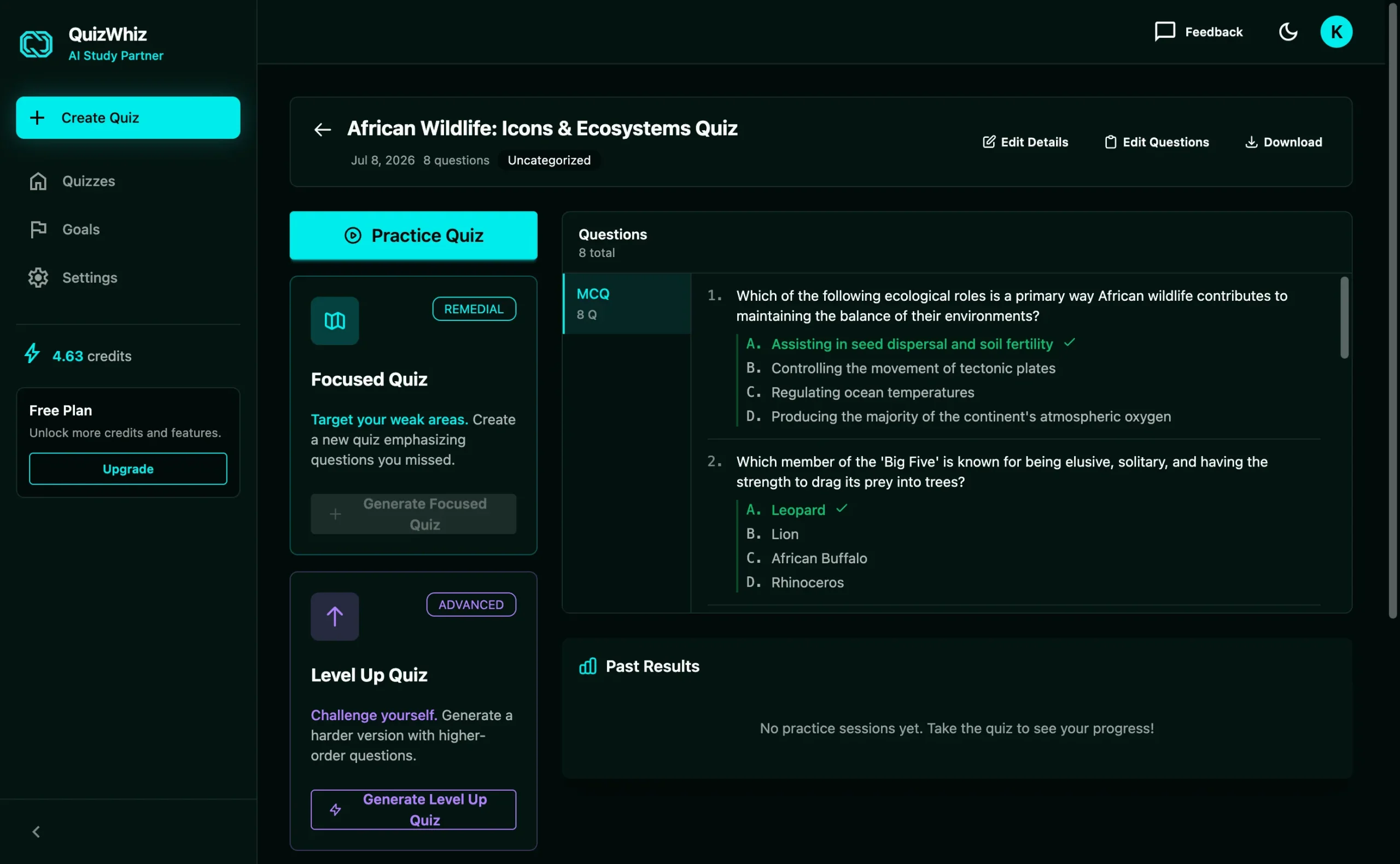
The finished quiz shows every question with the correct answer highlighted. You can edit the questions, take the quiz in “Practice Quiz” mode with instant feedback, or let QuizWhiz generate a “Focused Quiz” from the questions you missed and a harder “Level Up Quiz” once you improve.
Step 5: Download or Export
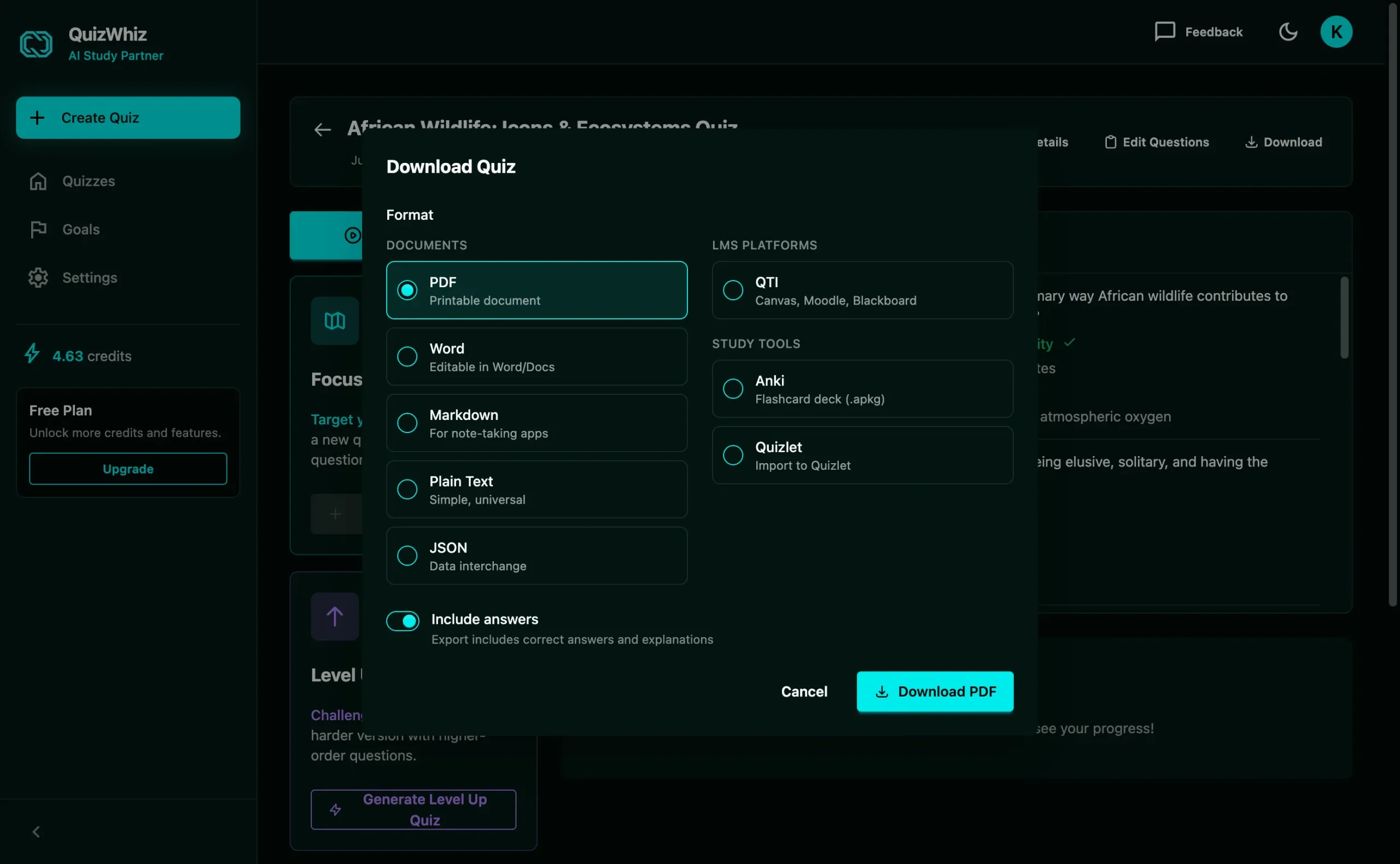
Click “Download” to export your quiz. QuizWhiz offers document formats (PDF, Word, Markdown, plain text, JSON), a QTI export for Canvas, Moodle and Blackboard, and study tool exports for Anki and Quizlet. You can include the correct answers and explanations with a single toggle.
Important notes when using QuizWhiz
- PDFs are limited to 10 MB, split larger documents before uploading.
- The extracted text is editable before generating, so remove irrelevant sections to get more focused questions.
- Generating a quiz costs around 5 credits and the free plan includes 10, enough for about two quizzes before upgrading.
- Use the QTI export to bring your questions into Canvas, Moodle or Blackboard without manual conversion.
The Bottom Line
The integration of Artificial Intelligence presents a promising avenue for streamlining the creation of educational material, including multiple-choice questions (MCQs) from PDFs.
It presents a transformative shift in educational assessment, offering educators efficiency, flexibility, and depth in crafting assessments that effectively evaluate student understanding and retention. As educators embrace these technological advancements, they offer more nuanced, adaptive, and impactful educational practices.
Frequently Asked Questions
Q: Can I create Multiple Choice Questions with ChatGPT?
A: Yes, ChatGPT and other AI tools can process large volumes of text quickly and generate multiple choice questions tailored to specific content and learning objectives.
Q: Are there any free AI multiple choice question generators?
A: Yes. SlideSpeak offers a free tool to create a quiz from a PDF, and ChatGPT can generate multiple choice questions for free with prompts like “Based on the following context generate me 10 multiple choice questions”. Quizgecko, Wayground and QuizWhiz also offer free plans.
Q: How can teachers create questions from chapter PDFs?
A: Upload the chapter PDF to a tool like SlideSpeak, ChatGPT or Quizgecko and ask for a set number of questions per chapter, for example “Create 10 multiple choice questions covering chapter 3”. If your textbook is one large PDF, split it into chapters first so the AI focuses on the right content, then repeat the process per chapter to build a question bank.
Q: What must you ensure when using AI to generate multiple-choice questions?
A: Always verify factual accuracy against the source material, make sure each question has exactly one clearly correct answer and plausible distractors, check that the questions align with your learning objectives and difficulty level, and watch out for questions that reference content the AI invented rather than what is actually in your PDF. A quick human review pass catches most issues.
Q: Can AI answer questions from multiple PDFs?
A: Yes. ChatGPT lets you attach several PDFs to one conversation, and tools like SlideSpeak let you chat with your uploaded documents. An educator who wants to create a multiple-choice quiz based on several articles can upload them together and prompt, for example, “Create a 15 question multiple choice quiz covering all three attached articles”.
Q: Are there any multiple choice generators from Word documents?
A: You can easily use ChatGPT or SlideSpeak to directly generate Multiple Choice Questions from the content of the document (DOC or DOCX). Check out our full guide on 6 ways to generate quizzes with AI from Word.
Q: How can you assess the quality of AI-generated multiple-choice questions before incorporating them into teaching materials?
A: Review the generated multiple-choice questions to ensure alignment with educational objectives, refine them as needed, and assess their relevance and difficulty level to ensure they effectively assess student understanding.
Q: How can I export and import multiple-choice question tests?
A: Exporting and importing multiple-choice question tests can be streamlined using several common formats such as CSV, XML, or QTI (Question and Test Interoperability). To export questions, first ensure your questions are formatted according to the requirements of the target platform. Tools like Quizgecko and QuizWhiz can export directly to LMS-compatible formats such as Moodle (Aiken), Canvas, Blackboard and QTI. For importing, upload the file to the new platform and follow the platform’s specific procedures to integrate the questions into your tests or quizzes. Always check for any specific format adjustments needed between different platforms to ensure compatibility and functionality.
Q: Can I generate multiple-choice questions with AI in Canvas?
A: AI-generated multiple-choice questions are highly compatible with Canvas, as long as they are exported in a format supported by the Canvas LMS, such as QTI. Most AI tools that generate multiple-choice questions can export the questions directly in this format or one that Canvas can import after minor conversions. Within Canvas, you can easily upload these QTI files through the “Quizzes” section by selecting “Import Quiz” from the course settings. This makes it straightforward to integrate AI-generated content into your course, enhancing the assessment variety and educational depth.
Q: Can I create multiple-choice questions with AI in Moodle?
A: You can’t do this directly, but AI-generated multiple-choice questions can be seamlessly integrated into Moodle. Moodle supports various import formats, including GIFT, Moodle XML, and Aiken, among others. To integrate AI-generated questions, first export the questions from your AI tool in one of the supported formats. Then, in Moodle, use the “Question bank” feature found under course administration to import your questions. This process allows for efficient use of AI tools to enrich Moodle-based courses with diverse and tailored assessment options, enhancing the learning experience for students.


