

84 Toolbox Talk Topics and Free Printable Templates
Written by

Published on
On this page
A toolbox talk is a short safety briefing run on the job, usually at the start of a shift, on one hazard the crew will meet that day.
Below are 84 toolbox talk topics: first 52 arranged as a calendar, one for each week of the year, then 32 more for the hazards a calendar can’t predict. Every topic comes from a published safety source.
Most lists of toolbox talk topics are alphabetical. That’s fine for looking something up, but useless for planning a year. The 52 calendar topics are built to be run start to finish. Each comes with a free one-page template in English and Spanish, with the talk and the signature block on the same page.
Toolbox talk topic picker
Not sure where to start? Press the button. It picks at random from all 84 talks on this page, and hands you the sheet where there is one.
Writing your own? Site-specific hazards are the one thing libraries can’t write for you. Build it with SlideSpeak: site details in, deck out.
84 toolbox talk topics
Our toolbox talk topics cover construction and general industry hazards, and the calendar is sequenced so seasonal risks land in the season they matter.
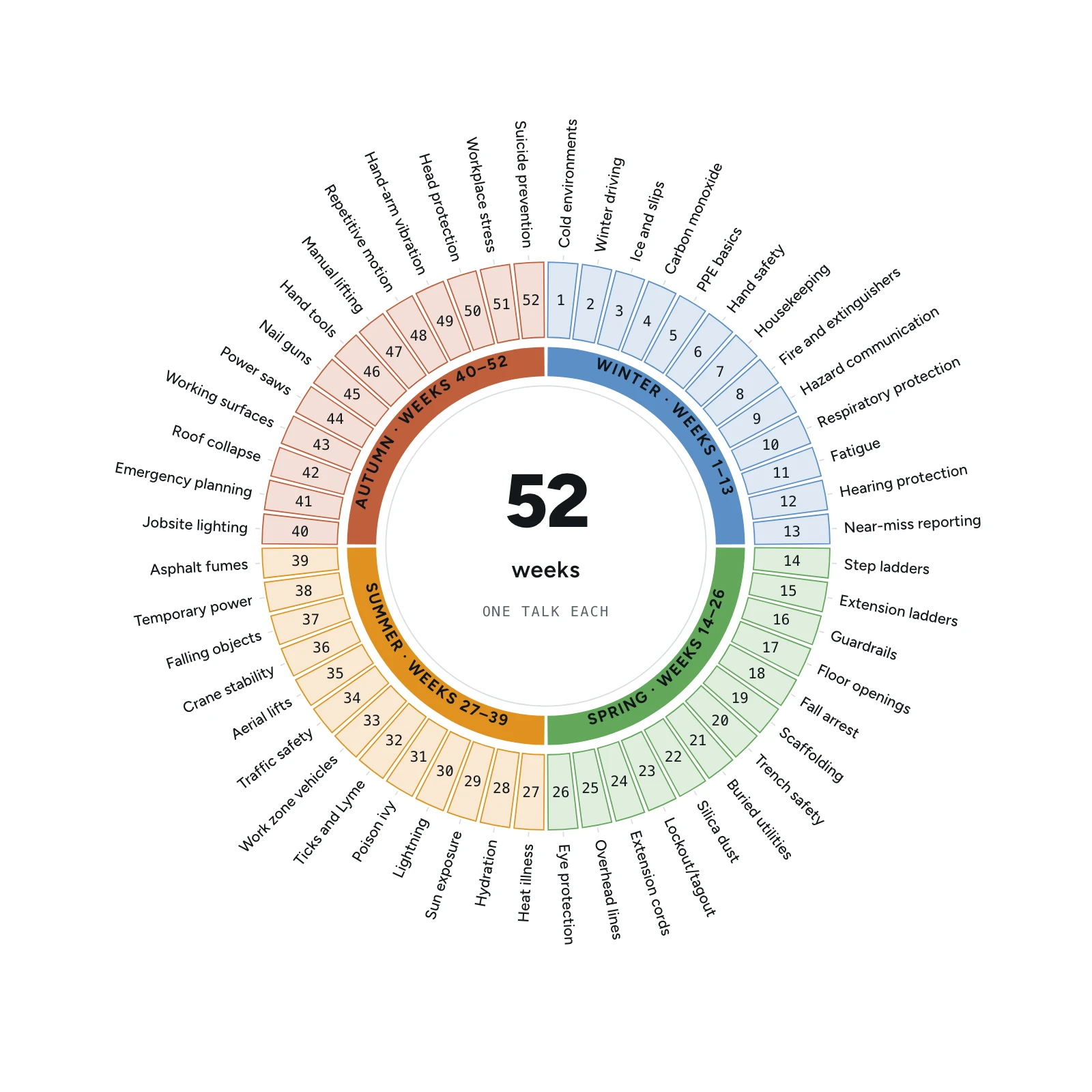
The topics come from published safety sources: the CPWR and OSHA Training toolbox talk libraries, plus the American Supply Association’s list. A few come from OSHA and NIOSH guidance, where no talk library covers them.
Five hazard families come back more than once across the year: falls, electrical, PPE, chemical exposure, and the human stuff like fatigue and stress. They repeat as a different angle each time rather than the same talk twice.
Winter toolbox talks
Cold, dark, and the quarter where temporary heat and ice do most of the damage.
| Week | Topic | Category |
|---|---|---|
| 1 | Cold environments | Weather |
| 2 | Driving safely in winter weather | Vehicles |
| 3 | Slips, trips, and falls on ice | Falls |
| 4 | Carbon monoxide poisoning | Chemical |
| 5 | Personal protective equipment basics | PPE |
| 6 | Hand safety and gloves | PPE |
| 7 | Housekeeping | Site |
| 8 | Fire safety and extinguishers | Fire |
| 9 | Hazard communication and GHS | Chemical |
| 10 | Respiratory protection | PPE |
| 11 | Shiftwork, long hours, and fatigue | Human |
| 12 | Noise and hearing protection | PPE |
| 13 | Near-miss reporting | Human |
Week 1: Cold environments
Cold cuts dexterity and reaction time before anyone feels properly cold, and cold stress does not wait for freezing temperatures. Run it the first full week back, when crews go from a break straight into the worst stretch of the year. Name the warm-up spot on your site and say who decides when people use it.
Week 2: Driving safely in winter weather
Most of the winter risk to your crew happens before they reach the gate. Three things get people: stopping distances on ice, black ice at first light, and a vehicle nobody cleared properly before moving it. Point at the specific route in and the specific lot, because that is where your people drive.
Week 3: Slips, trips, and falls on ice
Same-level falls get written off as bad luck, and they are the injury a talk can genuinely prevent. Freeze-thaw turns yesterday’s puddle into today’s hazard, and the refreeze spots repeat in the same places. Walk the site that morning, list the three worst, and say who is gritting them.
Week 4: Carbon monoxide poisoning
Temporary heat is what makes winter work possible and what makes it dangerous. Fuel-burning heaters, generators and engines running in part-enclosed spaces produce a gas nobody can smell. Go through every heater on the job, where it sits and what ventilation it has, because that changes as the building closes in.
Week 5: Personal protective equipment basics
Set the standard in week 5, while the year’s habits are still forming. The content is straightforward: what is required, who inspects it, and what happens when something is damaged or missing. The useful part is local: what is required at your gate, and what a worker does at 6am when their gear has failed.
Week 6: Hand safety and gloves
Hands take a large share of construction injuries, and cold makes it worse by cutting grip strength and sensation. The talk is glove selection against the actual task, rather than one pair for everything. Name the tools in use this month and which glove suits each, because cut resistance is no help on a hot surface.
Week 7: Housekeeping
Housekeeping is the hazard that creates other hazards. In winter that means mud tracked indoors, cable runs sitting in water, and material stacked where it landed because nobody wanted to be outside. Pick the two worst areas on your site and agree who clears them, instead of talking about tidiness in general.
Week 8: Fire safety and extinguishers
Heaters, fuel and combustible material in one enclosed space is a winter-specific combination. Cover the fire classes present on your site, which extinguisher suits which, and how to use one properly. Then walk people to where the extinguishers are, because knowing the theory and not the location is worth nothing at the time.
Week 9: Hazard communication and GHS
Every chemical on site should carry a label, and every worker should be able to read it. Run through the GHS pictograms, the signal words, and where the safety data sheets live. Make it real by pulling three actual containers off your site and reading the labels together, rather than showing the standard pictogram chart.
Week 10: Respiratory protection
Winter work moves indoors, which puts dust and fumes into poorly ventilated spaces. Cover which respirator suits which exposure, why fit matters, and why facial hair breaks the seal. The local question is which tasks on this job need protection now, and whether the people doing them have been fit-tested.
Week 11: Shiftwork, long hours, and fatigue
Short days and dark commutes turn fatigue into a seasonal hazard rather than a general one. Sleep debt eats reaction time and judgment. The last hour of a long shift is the one that hurts people, and both are worth saying out loud. Talk about the actual shift pattern on this job, including anyone doubling up.
Week 12: Noise and hearing protection
Hearing loss is the injury nobody notices happening. Enclosed winter work amplifies everything, so the same tool is louder indoors than it was outside in August. Cover protection types and when they are needed, then name the loudest task this week and who is working near it.
Week 13: Near-miss reporting
Close the quarter by resetting the habit that catches everything else. OSHA strongly encourages employers to investigate close calls, and a crew that reports them hands you problems while they are still cheap to fix. Keep this one mechanical: exactly how someone reports a close call here, and what happens next.
Spring toolbox talks
The quarter the work goes back outside and up. Falls, trenches, and dust dominate.
| Week | Topic | Category |
|---|---|---|
| 14 | Step ladders | Falls |
| 15 | Extension ladders | Falls |
| 16 | Fall protection: guardrails | Falls |
| 17 | Preventing falls through holes | Falls |
| 18 | Personal fall arrest systems | Falls |
| 19 | Scaffolding safety | Falls |
| 20 | Trench safety | Excavation |
| 21 | Buried utilities | Excavation |
| 22 | Silica dust | Chemical |
| 23 | Lockout/tagout | Electrical |
| 24 | Electrical safety: extension cords | Electrical |
| 25 | Overhead power lines | Electrical |
| 26 | Eye protection | PPE |
Week 14: Step ladders
Step ladders cause injuries because they feel too ordinary to respect. Four things to get through: the duty rating, standing above the marked top step, overreaching, and setting up on soft or sloped ground. Look at the step ladders on your site and ask when anyone last checked one for damage.
Week 15: Extension ladders
Higher work restarts in spring, and extension ladders are how most people get to it. The 4-to-1 setting angle and extending three feet above the landing are both required by 29 CFR 1926.1053. Add securing top and bottom, and three points of contact when climbing. The site-specific part is where a ladder can be tied off here, which is usually a shorter list than people assume.
Week 16: Fall protection: guardrails
Leading edges open up as structures go vertical, and guardrails are the protection that works without anyone remembering to clip on. Cover height, mid-rail, toe board, and what makes a guardrail non-compliant. Then walk every open edge on the job that day, because the answer changes weekly at this stage.
Week 17: Preventing falls through holes
Floor and deck penetrations get covered, then uncovered by whoever needed access, then forgotten. Marking, securing covers against displacement, and load requirements are the whole talk, but its value is naming where the holes are on your site right now and who is responsible for each cover.
Week 18: Personal fall arrest systems
Guardrails and covers protect anyone who forgets. A harness only protects the person wearing it properly, which makes this the fall talk that depends most on the individual. Cover anchor points rated for arrest and set above the worker wherever possible. Then inspection for cuts, burns, frayed webbing and distorted hardware, and staying tied off while moving between anchors rather than only once in position. Finish on suspension trauma, because a rescue plan invented while somebody is hanging is not a plan.
Week 19: Scaffolding safety
Scaffold goes up in spring and stays up for months, which is how a competent erection becomes an unsafe one. Cover access, planking, guardrails, and the rule against altering a scaffold you did not build. Say who the competent person is here and how a defect gets reported before someone works from it anyway.
Week 20: Trench safety
The ground becomes workable and the digging starts, and trench collapse gives no warning. Work through sloping, benching, shoring and shielding, plus the depth at which protection becomes mandatory. Talk about the depth and soil type on this specific dig, because that is what decides which protection applies.
Week 21: Buried utilities
Striking a live service is the excavation hazard people underestimate most, because the trench looks empty. Cover locating, marking, hand-digging near marks, and what to do when you find something unmarked. Go through what has been marked on this site and what the drawings show that the markings do not.
Week 22: Silica dust
Cutting, grinding and drilling ramp up in spring, and respirable crystalline silica is the exposure nobody can see happening. Explain where it comes from, why the damage is permanent, and what wet cutting or vacuum extraction does about it. Name the saws in use on this job and which control is fitted to each.
Week 23: Lockout/tagout
Equipment comes back into service in spring, which is when stored energy hurts people. The federal standard, 29 CFR 1910.147(d), sets out six elements, and the one crews skip is the last: verifying that the isolation actually worked. Go through the specific machines on this job, who holds the keys, and why removing someone else’s lock is never a shortcut.
Week 24: Electrical safety: extension cords
Temporary power is everywhere on a spring site, and cords take abuse no permanent installation would. Cover damaged insulation, missing ground pins, daisy-chaining, and correct rating for the load. Then walk the cords on your own site, because this is a talk that finds problems while you are giving it.
Week 25: Overhead power lines
Lifts, booms and material handlers come out in spring, and contact with an overhead line is usually fatal rather than injurious. Set out minimum approach distances and spotters, and why you never judge clearance by eye. Identify the lines over this specific site and which routes keep equipment away from them.
Week 26: Eye protection
Dust, debris and glare all rise together in spring, and eye injuries happen in the second nobody expected. Cover impact versus chemical protection, side shields, and why prescription glasses are not safety glasses. Pick the tasks on this site that need it and say what happens when someone shows up without it.
Summer toolbox talks
Heat is the headline, but the outdoor exposures around it are what get missed.
| Week | Topic | Category |
|---|---|---|
| 27 | Hot weather and heat illness | Weather |
| 28 | Hydration and acclimatization | Weather |
| 29 | Skin cancer and sun exposure | Weather |
| 30 | Lightning | Weather |
| 31 | Poison ivy and outdoor hazards | Site |
| 32 | Lyme disease and ticks | Site |
| 33 | Work zone safety around vehicles | Vehicles |
| 34 | Traffic safety | Vehicles |
| 35 | Aerial lift safety | Equipment |
| 36 | Crane safety and stability | Equipment |
| 37 | Preventing falling objects | Falls |
| 38 | Electrical safety: power | Electrical |
| 39 | Asphalt fumes and roofing | Chemical |
Week 27: Hot weather and heat illness
Heat illness escalates from cramps to exhaustion to heat stroke, and the last of those is a medical emergency rather than a bad afternoon. The warning signs matter in yourself and in the person next to you, since the affected worker is often the last to notice. OSHA’s guidance comes down to water, rest and shade: say where all three are on this site.
Week 28: Hydration and acclimatization
New crews and anyone back from a week off are the people heat hurts first, because the body needs gradual exposure to adapt. Cover why drinking only when thirsty is too late, and why acclimatization has to be built into the first days rather than assumed. Identify who started on this site in the last week.
Week 29: Skin cancer and sun exposure
The longest daylight of the year lands on a workforce that spends all of it outside, and the damage accumulates invisibly for decades. It comes down to covering up, sunscreen on exposed skin, and checking for changes rather than waiting for symptoms. Name which crews on this job are outdoors for the full shift.
Week 30: Lightning
Summer storms arrive faster than most sites can clear, and there is no safe outdoor position in a lightning storm. Cover the interval between seeing and hearing, why cranes and scaffolds are the worst place to be, and the wait before returning. The essential detail is where crews shelter on this specific site.
Week 31: Poison ivy and outdoor hazards
NIOSH lists construction workers among those at risk from poisonous plants, and the oil that causes the reaction transfers from clothing and tools as readily as from leaves. Identification, washing exposed skin, and never burning cleared vegetation are the three points. Point at where it grows on your site before anyone clears ground.
Week 32: Lyme disease and ticks
Tick exposure peaks in summer, and the bite that causes trouble is usually the one nobody noticed. Cover clothing, repellent, checking at the end of a shift, and correct removal. Say which parts of this site are wooded or overgrown, because that is where the risk is concentrated.
Week 33: Work zone safety around vehicles
Road season means crews on foot sharing ground with moving plant and public traffic. Talk through blind spots, backing, spotters, and high-visibility clothing that is clean enough to still work. Walk through the traffic pattern on this job, including where pedestrians and vehicles cross.
Week 34: Traffic safety
Public traffic is at its heaviest, and the driver approaching your work zone has no idea what is about to happen. Cover signage, tapers, flagger positioning, and the escape route every flagger should have picked before they need it. Talk about the specific public interface on this site.
Week 35: Aerial lift safety
Lifts are in heavy use through summer, and most serious incidents involve tip-over, ejection or crushing rather than mechanical failure. Ground conditions, guardrails, harness use where required, and never climbing out at height: those are the controls. Name which lifts are on site and who is trained on each.
Week 36: Crane safety and stability
Peak lifting season is when ground conditions and setup errors turn into collapses. Cover outrigger deployment, load charts, ground bearing, and why the lift plan changes when the ground has been rained on. Check the ground under the crane on this site and who signs off the lift.
Week 37: Preventing falling objects
Multi-level work peaks in summer, which means somebody is always working above somebody else. Run through tool tethering, toe boards, debris netting, and exclusion zones that people actually respect. The site-specific question is simple and uncomfortable: who is working below whom on this job today.
Week 38: Electrical safety: power
Temporary power runs under its heaviest load in summer, with more tools, more trades and more improvised connections. Cover GFCI protection, panel access, correct breaker sizing, and why a tripping breaker is information rather than an inconvenience. Identify the panel locations on this site and who is allowed to open them.
Week 39: Asphalt fumes and roofing
Roofing season peaks, combining fume exposure with heat and a work surface that offers no shade. The risks are fume inhalation, skin contact and burns from hot product, and part of the fix is positioning yourself upwind. Say which roof is being worked and which product is in use, because the exposure differs between them.
Autumn toolbox talks
Light goes, weather turns, and the year’s fatigue starts showing.
| Week | Topic | Category |
|---|---|---|
| 40 | Jobsite lighting and reduced daylight | Site |
| 41 | Emergency preparedness and storms | Site |
| 42 | Roof collapse | Structure |
| 43 | Walking and working surfaces | Falls |
| 44 | Power saw safety | Tools |
| 45 | Nail gun safety | Tools |
| 46 | Hammer and hand tool safety | Tools |
| 47 | Lifting and carrying materials | Ergonomics |
| 48 | Repetitive motion and carpal tunnel | Ergonomics |
| 49 | Hand-arm vibration | Ergonomics |
| 50 | Head protection | PPE |
| 51 | Workplace stress | Human |
| 52 | Suicide prevention | Human |
Week 40: Jobsite lighting and reduced daylight
The clocks change and the work does not, so crews start and finish in the dark on the same schedule they kept in July. Cover task lighting, walkway lighting, and the way temporary lights create glare and shadow rather than removing them. Walk the site at the hour it is now darkest and find where people cannot see.
Week 41: Emergency preparedness and storms
Storm season is the wrong time to discover nobody knows the plan. Four things: the muster point, the head count, who calls it, and how the site is made safe before people leave. Confirm the muster point on this job, because it moves as the site changes and often nobody announces it.
Week 42: Roof collapse
Water pools and early snow loads a roof faster than most people expect, and the failure gives little warning. Cover drainage, load accumulation, and why standing on a suspect roof to inspect it is the wrong move. Identify the roofs and temporary canopies on this site and who checks them after weather.
Week 43: Walking and working surfaces
Wet leaves, mud and the first ice arrive together, and the routes people take are habitual rather than chosen. Talk about housekeeping on walkways, edge protection, and reporting a surface before someone else finds it. Name the worst route on this site and agree what gets done about it this week.
Week 44: Power saw safety
Indoor fit-out ramps up and the saws come with it. Cover guarding, kickback, blade selection, and the hand position that people abandon when they are in a hurry. Say which saws are in use on this job and who checks the guards on them.
Week 45: Nail gun safety
Framing and finish work drive most nail gun injuries, and the trigger type matters more than the training. The content is sequential versus contact trip, keeping the free hand clear, and never disabling the safety contact. Establish which trigger type is on the tools here, because that single fact changes the risk.
Week 46: Hammer and hand tool safety
Hand tools get skipped in safety talks because they seem too basic to discuss, which is exactly why they keep injuring people. Cover damaged handles, mushroomed heads, using the right tool for the job, and safe carrying. Look in the bags on this site and see what is actually in them.
Week 47: Lifting and carrying materials
Material moves indoors for the winter fit-out, which means more manual handling in tighter spaces. Work through assessing the load, team lifts, route planning, and setting down as carefully as picking up. Name the heaviest thing being carried by hand on this job and ask whether it needs to be.
Week 48: Repetitive motion and carpal tunnel
Cumulative strain shows up at the end of the year, after eleven months of the same movement. Cover early symptoms, why people work through them, and what rotation or tool changes reduce the load. Identify which trades on this site are most exposed, because it is rarely spread evenly.
Week 49: Hand-arm vibration
Cold and vibration compound each other, which makes late autumn the point where damage accelerates. Explain reduced circulation, the early numbness people dismiss, and limiting continuous trigger time. Say which tools on this job vibrate most and how long anyone is holding them.
Week 50: Head protection
Overhead work in tight winter spaces is when heads meet structure. Cover inspection for cracks and UV damage, replacement intervals, correct fit, and why a hard hat that has taken an impact is finished. Point at the overhead risks on this site rather than talking about head protection in the abstract.
Week 51: Workplace stress
Year-end deadlines and holiday pressure land on people at the same time, and stress shows up as inattention before it shows up as anything else. The three things to name are workload, recognizing it in colleagues, and what support actually exists. Talk honestly about who is carrying the most on this job right now.
Week 52: Suicide prevention
Construction carries a high suicide rate and the last weeks of the year are a high-risk stretch. Cover the warning signs, why asking directly is safer than avoiding the subject, and how to stay with someone rather than hand them a leaflet. Give the actual number people can call, out loud, and make sure it is somewhere they can find it later.
32 more toolbox talk topics worth keeping on file
A calendar can’t predict a tank entry, a lead abatement, or the week a tower crane arrives. The 52 above are a rotation you can run without thinking. These 32 are the rest of the library. These are the ones you swap in when the work calls for them, and the reason to keep a wider library than the year needs.
They come from the same published sources as the calendar. None of them gets a printed sheet in this set, because a sheet is only worth building for a talk you will run more than once. If one of these becomes routine on your sites, promote it into the rotation and drop whichever week it beats.
Powered industrial trucks and forklifts
One of OSHA’s most frequently cited standards, and the person hurt is rarely the driver. Pedestrians in blind corners, unstable loads and a truck left running on a slope do most of the damage. Run it on any site with a forklift, and name the places here where people and trucks share the same ground.
Machine guarding
Also among the most frequently cited. Guards come off for a jam or a changeover and stay off, because refitting them costs a minute every single time. Run it wherever you have fixed plant or a fabrication area, and find the machine on this site running with a guard that has been defeated.
Skid steer loaders
Small, quick, and responsible for a lot of crushing injuries to people standing where the operator cannot see. Run it the week one arrives. Agree who is allowed to operate it, where it will travel, and how someone on foot signals before approaching.
Equipment maintenance
Maintenance is when guards come off, energy is stored and the machine sits in a state nobody expects. Run it before a planned maintenance window. Confirm who isolates, who holds the lock, and what happens if the work runs past the end of the shift.
Getting on and off equipment
More injuries come from mounting and dismounting than from operating. Jumping down from the last step, wet boots and a missing handhold do it. Run it when new operators arrive or after anyone slips, and check the steps and grab rails on the machines here.
Arc welding and electrical safety
The welder is an electrical source that people stop treating as one. Damaged leads, wet ground, poor earthing and a return path through the structure are the usual causes. Run it before hot work starts, and inspect the leads and the return clamp on this job.
Arc welding and fire safety
Sparks travel further than anyone expects and smoulder for hours after the work stops. Run it the same week as the electrical talk, paired with the fire watch. Walk the area under and around the work, name what is combustible, and agree who stays behind afterwards.
Arc flash
Live panel work can produce an arc that burns hotter than anything on site protects against by accident. Run it before any work on energised equipment. Establish who is qualified, what the boundary is, and whether the job could be done de-energised instead.
Lead exposure
Renovation and demolition of older buildings release lead from paint and coatings, and the exposure is invisible and cumulative. Run it before any work that disturbs old finishes. Confirm what has been tested on this building, and what containment and washing exist.
Isocyanates
Spray foam and two-part coatings can sensitise someone permanently, and after that any future exposure is a problem. Run it before spray work starts. Identify who is applying, who is working nearby, and what ventilation and respiratory protection are actually in place.
Solvents
Vapour builds in an enclosed space faster than people notice, and the consequences run from headaches to fire. Run it on any job using solvent-based products. Read a label together, check the ventilation where it is being used, and find out where the empties go.
Wet concrete
Wet concrete burns slowly enough that people ignore it until the damage is deep, and kneeling in it is worse than touching it. Run it during pour weeks. Name where crews contact it, check that boots and gloves seal, and agree where washing water is.
Drywall handling
Repetitive, awkward and heavy, and the injuries are backs, shoulders and hands rather than anything dramatic. Run it during fit-out. Look at how sheets are moving on this floor and whether a cart or a second pair of hands would remove the worst of it.
Tuckpointing
Grinding out old mortar produces silica dust in quantity, usually on a scaffold with nowhere for it to go. Run it during masonry restoration. Check which grinders have extraction fitted and who else is working on the same face at the same time.
Silica dust in enclosed cabs
Cab-operated cutting and milling puts the operator inside the dust cloud with the ventilation drawing it in. Run it before that work starts. Confirm the cab filtration works, the doors and windows seal, and that somebody has actually changed the filters.
Confined spaces
Most confined space deaths include a would-be rescuer who went in after the first casualty. Run it before any permit-required entry. Establish who tests the atmosphere, who attends, what the rescue arrangement is, and that nobody goes in to help without one.
Hydrogen sulfide
It smells of rotten eggs at low concentration and then deadens your sense of smell, so the warning disappears as the danger rises. Run it before sewer, tank or digester work. Confirm the monitors are calibrated and that everyone knows the evacuation signal.
Biohazards
Renovation, sewage work and animal waste all carry an infection risk that looks like ordinary dirt. Run it before work in any contaminated area. Agree the protection, the washing facilities, and what somebody does after a splash or a puncture.
Histoplasmosis
Bird and bat droppings in old structures carry a fungal spore that causes lung disease when it is disturbed. Run it before clearing a loft, a tower or a derelict building. Check whether the deposits have been identified and what wetting and protection will be used.
Ultrafine particles and nanomaterials
Nano-enabled concretes, coatings and insulation behave differently from the bulk material, and the exposure limits are not settled. Run it before working with any of them. Read what the manufacturer actually says and decide what protection follows from it.
Tower crane safety
Erection, climbing and dismantling are the highest-risk phases, and they involve people who are not on this site every day. Run it before any of the three. Confirm the exclusion zone, who is coordinating, and the wind limits for this particular machine.
Boom truck safety
Delivery-heavy weeks put a crane on the back of a truck in a spot nobody surveyed. Run it before a run of deliveries. Check the ground under the outriggers, what is overhead, and where people will be standing while the load comes off.
Planning a lift
A lift plan that lives in an office is not a lift plan. Run it before any critical lift, and walk through weight, radius, ground, rigging, signals and exclusion zone with the people who will actually do it. Agree out loud what stops the lift.
Falls from heavy equipment
Mud, ice, fuel and worn steps turn the machine itself into a fall hazard. Run it after wet or freezing weather, or when new operators arrive. Check the condition of the steps and grab rails, and agree that nobody jumps down from the last one.
Night shift road work
Reduced visibility, tired crews, and drivers who are measurably worse at night. Run it before any night closure. Check the lighting layout, high-visibility clothing rated for dark conditions, and where the crew can get off the carriageway in a hurry.
Bloodborne pathogens
Anyone giving first aid, or anyone who finds a discarded sharp, can be exposed. Run it with your first aiders or after a sharps find. Confirm where the kit is, what gloves and barriers are in it, and exactly who a person tells if they think they have been exposed.
Opioid deaths in construction
The industry’s injury rate and its prescribing pattern make this a workplace issue rather than a private one. Run it alongside the stress and suicide prevention weeks. Say plainly what support exists, and whether naloxone is available on this site.
Cell phone distraction
A phone takes attention off a hazard for roughly as long as it takes the hazard to arrive. Run it after any near miss involving one. Agree where phones are and are not used here, and who that applies to, supervisors included.
Incident response
The minutes after an incident decide much of the outcome, and nobody improvises well under that pressure. Run it at new site setup, or after anything happens. Establish who calls, what the site address is, where the kit lives, and who meets the ambulance.
Attitudes and behaviors that contribute to accidents
Rushing, frustration, fatigue and complacency come before most incidents, and all four are visible before anything goes wrong. Run it when the rotation starts to feel stale, and ask which of the four is most present on this job this week.
Respiratory illness and COVID-19
Shared cabs, welfare units and enclosed work make transmission a practical problem whatever the current policy says. Run it during an outbreak, or when a client requires it. Confirm what the requirements are now and how somebody reports being unwell.
Radiofrequency radiation
Rooftop work near antennas can expose people to RF levels they cannot see or immediately feel. Run it before any roof work near transmitters. Find out who owns the antennas, whether they can be powered down, and what the exclusion distances are.
What is on each sheet
Every one of the 52 topics in the calendar above comes as a one-page toolbox talk template, in English and Spanish, laid out identically:
- A header: project or site, date, and talk led by.
- The hazard, in two sentences.
- What goes wrong, as four bullets.
- The controls to check before work starts.
- Four questions to ask the crew. The part most talks skip, and the part that makes anyone speak.
- Twelve numbered signature rows, printed name and signature, plus a supervisor sign-off.
- A footer telling whoever ran the talk to scan it and send it back to the project office.
Twelve rows fits a normal crew on one page without squeezing the talk to make room.
Which of these talks matter most
If you can only prepare a handful properly, prepare the ones that kill people. Falls, struck-by, caught-in and electrocution are the four hazards behind most construction deaths, and they are also what inspectors write up: fall protection, ladders and scaffolding sit near the top of OSHA’s most-cited standards every year, alongside hazard communication and lockout/tagout.
That points at about a dozen talks worth real work: guardrails, falls through holes, personal fall arrest, step and extension ladders, scaffolding, trenches, overhead power lines, extension cords, work zone vehicles, falling objects, lockout/tagout and hazard communication. Prepare those with the site in mind. The rest can run off the sheet.
How to make a generic topic fit the site you’re standing on
Every published toolbox talk is generic, and the good libraries say so upfront. The OSHA Training library describes its talks as “generic enough to be applied to many different work environments.” That’s the selling point and it’s the problem.
Take week 22: silica dust
The generic version explains what respirable crystalline silica is, why it’s harmful, and that you need engineering controls. All true, and a crew has heard it before.
The site-specific version answers four questions the generic one can’t:
- What’s cutting on this site this week? Name the saw, the wall, the slab.
- Which control is actually fitted? Wet cutting, vacuum shroud, or nothing yet.
- Who’s exposed who isn’t doing the cutting? The trades working downwind of it.
- What changed since last time? New contractor, new phase, new location.
Answer those four and you’ve turned a generic talk into a briefing about today.
Those four are the ones no library can answer for you. Everything else in a published talk is the same on every site in the country: what silica is, what it does to lungs, what the exposure limit is. That’s exactly why someone was able to write it down in advance. The site-specific part is the part that had to wait for you.
Miss it and two things happen, and the second is worse. The crew stops listening, because a talk that could have been given anywhere is one they’ve already heard. And your record ends up showing a talk on silica in the same week three trades were dry-cutting block on the second floor. A record that doesn’t match the site is worse than no record, because it’s evidence you looked and didn’t see.
Now do that twenty-five times
The scale is the hard part, not the thinking. One site, and adapting a talk is ten minutes with a pen. Twenty-five sites, and you’re writing 25 separate documents, each naming different contractors and a different layout, before anyone has said a word to a crew.
So the firms doing this well build the four answers into a template and fill them in per site, rather than rewriting the talk each time. If you build presentations for these, SlideSpeak will generate one from a prompt or from documents you already have, then export it to PDF or PowerPoint. The site details go in, a deck comes out, and nobody rebuilds the same talk 25 times.
Run every talk in English and Spanish
Always produce every talk in English and Spanish as standard, not on request.
The materials themselves aren’t the gap. CPWR publishes its entire library in both languages, free. Raken ships a bilingual library too, though its Spanish topics are a subset of the English ones and toolbox talks sit on its higher plan rather than the entry one.
So if you only ever run pre-written talks, this is close to a solved problem. Go and download them.
The gap opens the moment you write your own. The talk that matters most is the site-specific one from the section above, the one naming this week’s saw, this week’s contractor, this week’s open edge. No library has it in either language, because it didn’t exist until you wrote it.
You can use SlideSpeak to translate your talks, whether in PDF form, deck, or video.
Frequently asked questions
What is a toolbox talk?
A toolbox talk is a short safety briefing delivered to a work crew on the job, usually at the start of a shift, covering one hazard relevant to that day’s work. They’re also called tailgate meetings, safety briefings, or crew safety meetings, and California’s regulations use “toolbox” and “tailgate” interchangeably.
How do you conduct a toolbox talk?
Pick the hazard the crew will actually meet that day, and open with it rather than with background. Work from a one-page prompt instead of reading a script, and ask at least one question the crew answers. Then record who attended. The whole thing works better standing where the hazard is than in a trailer.
What is a toolbox talk template?
A toolbox talk template is a one-page sheet used to run and document a short safety briefing, with the talk on the top half and the attendance signatures on the bottom. The talk half gives whoever is leading it something to say. The signature half proves it happened. Most templates online are only one of those two things.
Do I need a separate toolbox talk attendance form?
Not if the talk sheet already has a signature block on it. A separate attendance form is the most common setup, and it means two documents and two chances to lose one, with a signed sheet nobody can connect back to a topic. Every template here puts both on one page for that reason. Across enough crews, paper stops scaling and the signature chase becomes the job, which is what toolbox talk software exists to solve.
What is a toolbox talk in construction?
The same thing, with construction hazards: falls, trenches, silica, struck-by, electrical. Construction is also where the requirements bite, because both state rules that mandate a meeting frequency apply specifically to construction crews.
How do you give a toolbox talk if you’re not a trainer?
Most people running these are foremen and crew leaders, not safety professionals, and Washington’s rule is written for exactly that person. You don’t need to be an expert on the hazard. You need to name it, say what’s being done about it on this site, and let the crew tell you what you missed.
Final thoughts
The toolbox talk topics are the easy part. Any of the libraries linked here will give you a hundred of them for free, and you can have next week’s talk in about four minutes. The hard part is keeping it consistent week over week and year over year.
The firms that keep this going took the decision away from the person who’s busiest. A fixed rotation, sequenced against the season, means nobody spends Thursday night wondering what Friday’s talk is. Past a handful of sites, they also stop running it on paper: we compared 10 toolbox talk software platforms on scheduling, sign-off and reporting.
If you take one thing from the rotation above, take the last line of each entry. The rotation tells you what to talk about. The site in front of you is the only thing that makes anyone listen.
If you’d rather deliver the talk on a screen than on paper, you can build a deck from any of the sheets with SlideSpeak, or turn a finished deck back into printed handouts for the crew. For teams building longer safety modules rather than daily talks, we’ve compared the best AI tools for creating safety training videos.


