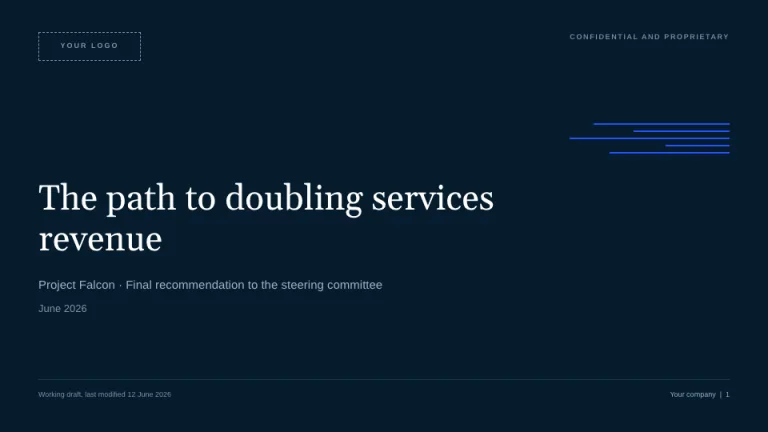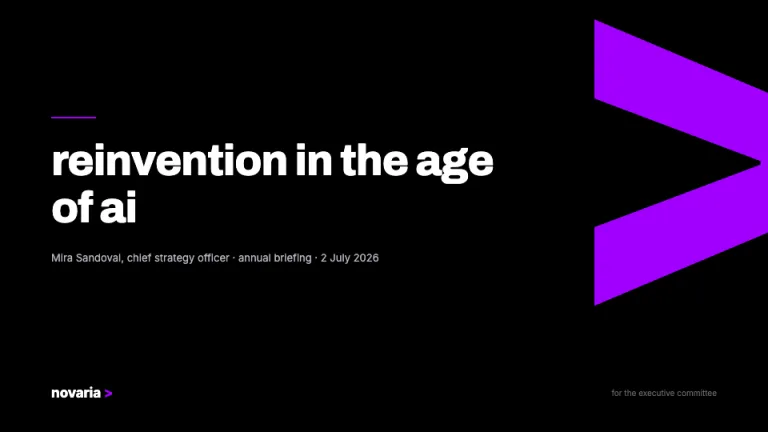
About this design
Where the Arthur D. Little Style style comes from, and what it signals.
Arthur D. Little Style recreates the look of a recent Arthur D. Little presentation or Blue Shift report: deep indigo #0d003f type on white, electric cyan #00eaff fields and a four-step blue ramp for charts. The exhibits borrow from the playbook the firm published for managing technology as a portfolio. Arthur D. Little has not licensed or endorsed this homage.
Titles and body run in Manrope, a Google Fonts stand-in for CA Saygon, the proprietary face in the firm's reports. Each content title carries a 3px cyan underline lifted from the report headings. A thin left rail runs the client and study name up its edge with the page number at its foot, and tables keep the report grammar: an indigo header row, cyan labels and technology names in cyan-filled first cells.
Use it for a technology strategy presentation when you have to decide where R&D money goes. The signature slide is the technology radar, with base, key, pacing and emerging rings, the classification Arthur D. Little published in Third Generation R&D. Add the S-curve slide to mark when a successor technology overtakes yours, and the industry maturity matrix to place each business unit before you fund it.
Use it for
- Technology strategy and R&D portfolio reviews for an executive board
- Innovation audits that sort technologies into base, key, pacing and emerging
- Technology scouting reports with S-curve and readiness (TRL) exhibits
- Business unit portfolio reviews on an industry maturity matrix
- Engineering-led companies briefing investors on their next product generation
Skip it for
- Answer-first strategy readouts with no technology angle; McKinsey Style or Bain Style fit that job
- Vendor evaluations on a quadrant or wave chart; use Gartner Style or Forrester Style
- Startup fundraising decks that lead with traction numbers; use Midnight Pitch or Sequoia Pitch Deck
The presentation design prompt
This is the exact text that gets sent to your AI.
Create a presentation in the 'Arthur D. Little Style' theme, an unofficial homage to Arthur D. Little's technology strategy reports. Palette: white #ffffff content slides; indigo #0d003f for all text, axes and table headers; electric cyan #00eaff for fields, underlines and fills, never for text on white; a blue shift chart ramp of #093a6f, #06749e, #03afce and #00eaff; pale cyan #dffcff for bands and highlights; muted #686087 for sources and axis labels; rules #e2e0e8; panels #f5f4f7. Typography: 'Manrope' (Google Fonts) throughout. Content titles 800 weight at 22 to 24px, sentence case, a full-sentence takeaway, two lines max, underlined with a 3px #00eaff line offset 6px; body 400 to 500 at 12 to 14px, stats 800 at 24px. A 44px left rail with a 1px #e2e0e8 border holds the client and study name vertical in 10px #686087, and the page number in 15px 800 indigo under a short cyan bar at its foot. Exhibits carry a bold 12px 'Fig 3: ...' label above and a 10px 'Source: ...' line below. Cover: full-bleed #00eaff field, study title in 50px 800 indigo, subtitle, authors, city and date; faint indigo radar arcs in one corner; a 140px indigo band on the right with the report type set vertically in 76px cyan capitals. Signature slide, the technology radar: a half circle split into three domain sectors by white lines, four rings from the center out, Base #03afce, Key #00eaff, Pacing #9ff3ff, Emerging #dffcff, indigo blips with direct labels, and pacing bets drawn larger with a white halo and bold labels; a side legend gives each ring's meaning and move (buy, protect, build options, watch). S-curve slide: two S-curves on one axis, the incumbent in 3px indigo flattening, the successor in 3px #03afce overtaking it inside a pale cyan crossover band, 'today' as a haloed dot; beside it an 8px vertical gradient bar from #0d003f to #00eaff next to three stats. Chapter dividers: full-bleed indigo, a 190px cyan hash chapter number (#2), a white title, and a contents list where only the current chapter turns cyan and white. Tables: indigo header row with 11px bold cyan labels, first-column cells filled cyan (pacing rows) or #dffcff with bold indigo names, 1px #e2e0e8 row rules, TRL readiness, Harvey balls for impact. Maturity matrix: industry maturity (embryonic to aging) by competitive position (dominant to weak), zones tinted #9ff3ff, #dffcff, #f5f4f7 and white, units as bubbles sized by revenue, dashed circles and arrows for targets. Strictly avoid: logos, wordmarks or a stylized raised D, claiming affiliation with Arthur D. Little, cyan text on white, rainbow charts, red or orange accents, drop shadows, rounded cards, stock photos, 3D charts, gridlines, legends where direct labels fit, topic-only titles, centered body text, all-caps titles on content slides.

Use this theme for my slides. Ask me what the presentation is about first, then apply the theme to every slide.
View this prompt and its data on GitHub
How to use this prompt
From copied text to a finished Arthur D. Little Style deck in four moves.
- 01
Copy the prompt
Use the copy button, or open it pre-filled in Claude or ChatGPT with one click from the panel on this page.
- 02
Tell the AI your topic
The prompt instructs the AI to ask what your presentation is about first. A sentence or a pasted outline is enough.
- 03
Generate and iterate
Ask for more slides or swap a layout. The avoid list at the end of the prompt keeps Arthur D. Little Style on-style while the content changes.
- 04
Or skip straight to a deck
SlideSpeak turns your topic or document into a finished Arthur D. Little Style presentation, exportable as PowerPoint or PDF.
Common questions
Working with the Arthur D. Little Style presentation design prompt in practice.